LAWLS Bookstore

Showing posts with label food safety. Show all posts

Thursday, April 27, 2017

USDA FoodKeeper App - A Tool You Must Use!

I have not been compensated for this post: This is information that we all need as part of our healthy lifestyle program and I'm tickled to share with you the valuable resources from USDA that I've come to count upon in my kitchen and home.

Hello Dear Readers, thanks for joining me here today and happy Spring to you all.

If you've been with me for very long you know one of my nag-topics is food safety and kitchen hygiene. For myself, and for so many of you, I know having a bariatric surgery was not only a means to weight loss and healthy weight management: it was an opportunity for a new start in the pursuit of living better, healthier lives. That includes becoming schooled in matters of food handling safety, proper food preparation and storage, and protecting myself and family from foodborne illness.

The USDA is my go-to source for current and meaningful information that promotes, "kitchen confidence" -- simply the confidence in your ability to safely prepare delicious meals for your loved ones and yourself. Food safety and kitchen confidence is no trivial matter. The Centers for Disease Control and Prevention (CDC) estimates that each year approximately 48 million Americans suffer from foodborne illnesses, leading to 128,000 hospitalizations and 3,000 deaths. The CDC says "Many of these illnesses can be prevented by changing behaviors in the kitchen and gaining a little kitchen confidence."

FoodKeeper Mobile App
Earlier this month the USDA invited home cooks to improve their kitchen confidence by visiting their remarkably user-friendly website Foodsafety.gov and making use of their go-to quick reference guide to food safety with the free and friendly app: FoodKeeper for iOS and Android.

"The FoodKeeper helps you understand food and beverages storage. It will help you maximize the freshness and quality of items. By doing so you will be able to keep items fresh longer than if they were not stored properly. It was developed by the USDA's Food Safety and Inspection Service, with Cornell University and the Food Marketing Institute. It is also available as a mobile application for Android and Apple devices."
Find the app at FoodKeeper or get it directly from your App store on your favorite mobile device.

This image shows the information on storing and consuming shredded cheese. Notice how clean and concise the information is presented - no lengthy explanation, just the simple facts. The clean presentation makes sense because the question "I wonder if this is still good?" is usually asked when we are engaged and lack the time for lengthy reading and research. A couple of quick clicks and we are in the know, good to go!


I hope you will check out the FoodKeeper App and the FoodSafety.gov website to build your kitchen confidence and keep your family healthy and happy as you enjoy meals together.

Safety Tips to Prevent Food Borne Illness This Summer 

Monday, December 08, 2014

Food Safety at the Office

"Over the years I've heard from so many weight loss surgery patients that their sensitivity to food illness increased after surgery. The best way to prevent food illness is to ensure the proper safe food handling steps are taken with all the food we prepare and eat." Kaye Bailey


Today we continue our series on food safety with a focus on  food and events that are most common during the winter holiday season from Thanksgiving through New Years. 

Improperly prepared, served, and stored food can harbor bacteria that leads to food borne illness. Over the years I've heard from so many weight loss surgery patients that their sensitivity to food illness increased after surgery. The best way to prevent food illness is to ensure the proper safe food handling steps are taken with all the food we prepare and eat. Extra caution should be used when eating foods away from home that might include picnics, buffets, box lunches, dinner parties, etc. We cannot always control the way our food is handled or served, but we can pay close attention to the details and avoid food that is served at the wrong temperature or has been sitting too long on the buffet table.

The Office Holiday Party: Keeping Food Safe

Today's article in our food safety series takes a look at the office holiday party. Often the holiday party is potluck with everyone contributing a dish to the meal. Few offices are equipped for food service so keeping the food in the proper environment may be difficult. Here are tips from the Foodsafety.gov blog by Amelia Kermis, MPH CHES, Food Safety Education Staff, Food Safety and Inspection Service, USDA. Link to original article.

"Keep Hot Food Hot. Hot items are best served immediately after cooking or reheating. If you plan on serving a hot item at the office party, take it straight from the oven and either place it in an insulated bag or hot food carrier. If you can’t serve it as soon as you arrive, return it to the oven. Alternatively, you can completely chill the item and transport it according to Tip 2. Once you arrive at the office reheat it using a microwave, stove, or oven to 165 °F.

Keep Cold Food Cold. Cold items should remain in the refrigerator for as long as possible. When transporting cold dishes, place items in a cooler with plenty of ice or frozen gel packs. A refrigerator thermometer in the cooler is a useful way to make sure items remain at proper chill temperature of 40 °F or below.

Use Several Small Platters. For both hot and cold items, arrange and serve food on several small platters rather than on large platter. This way you can hold food at safe temperatures (cold foods below 40 °F and hot foods above 140 °F) until party-goers are ready to eat it.

Keep Track of Time. Keep track of how long items have been sitting on the buffet table and discard anything out longer than two hours. You never want to leave perishable foods, such as meat, poultry, eggs and casseroles in the “Danger Zone” over two hours. The danger zone is between 40 and 140 °F where bacteria multiply rapidly. After two hours, enough bacteria may have grown in your food to make party-goers sick. Exceptions to the danger zone include ready-to-eat items like cookies, crackers, bread and whole fruit."

After: Don't Lose Food in the Fridge

After the party take home or discard the left over food you provided and encourage others to do so as well. We have all see the office refrigerator become a no-man's land of containers harboring relics of the past. In fact, OSHA often cites the office refrigerator as one of the most hazardous places in the office. Workers in California found out the hard way that a refrigerator used as a receptacle for unwanted and forgotten food can be hazardous to their health. In May 2009 the AT&T call center in San Jose was evacuated of 325 employees. Fifty firefighters with 18 emergency vehicles responded to the call. Twenty-eight sickened employees received first aid or were transported to the emergency room. The cause? Unidentifiable left-overs gone rogue in the office refrigerator.

Food safety isn't just for your home kitchen. Take it to work with you as well!

For more great food safety tips check out these previous articles:
Clean Your Refrigerator DayThanksgiving Food Safety
Thaw Turkey Safely
Keeping Buffet Food Safe

Wednesday, November 26, 2014

The Holiday Buffet: Food Safety Tips!

The countdown to Thanksgiving is now hours, not days. Here for a quick refresher I share the basics of a safe holiday party food buffet as instructed by USDA Food Safety and Instruction Service. These are the highlights, link to the full article here: Buffet Food Safety.


Holiday or Party Buffets

A popular way to celebrate holidays or any party occasion is to invite friends and family to a buffet. However, this type of food service where foods are left out for long periods leave the door open for uninvited guests — bacteria that cause foodborne illness. Festive times for giving and sharing should not include sharing foodborne illness. Here are some tips from the USDA's Meat and Poultry Hotline to help you have a SAFE holiday party. 
 
Safe Food Handling
Always wash your hands before and after handling food. Keep your kitchen, dishes and utensils clean also. Always serve food on clean plates — not those previously holding raw meat and poultry. Otherwise, bacteria which may have been present in raw meat juices can cross contaminate the food to be served.

Cook Thoroughly
If you are cooking foods ahead of time for your party, be sure to cook foods thoroughly to safe minimum internal temperatures.
  • Cook all raw beef, pork, lamb and veal steaks, chops, and roasts to a minimum internal temperature of 145 °F as measured with a food thermometer before removing meat from the heat source. For safety and quality, allow meat to rest for at least three minutes before carving or consuming. For reasons of personal preference, consumers may choose to cook meat to higher temperatures.
  • Cook all raw ground beef, pork, lamb, and veal to an internal temperature of 160 °F as measured with a food thermometer.
  • Cook all poultry to a safe minimum internal temperature of 165 °F as measured with a food thermometer.
Use Shallow Containers
Divide cooked foods into shallow containers to store in the refrigerator or freezer until serving. This encourages rapid, even cooling. Reheat hot foods to 165 °F. Arrange and serve food on several small platters rather than on one large platter. Keep the rest of the food hot in the oven (set at 200-250 °F) or cold in the refrigerator until serving time. This way foods will be held at a safe temperature for a longer period of time. REPLACE empty platters rather than adding fresh food to a dish that already had food in it. Many people's hands may have been taking food from the dish, which has also been sitting out at room temperature.

The Two-Hour Rule
Foods should not sit at room temperature for more than two hours. Keep track of how long foods have been sitting on the buffet table and discard anything there two hours or more.
 
Keep Hot Foods HOT And Cold Foods COLD
Hot foods should be held at 140 °F or warmer. On the buffet table you can keep hot foods hot with chafing dishes, slow cookers, and warming trays. Cold foods should be held at 40 °F or colder. Keep foods cold by nesting dishes in bowls of ice. Otherwise, use small serving trays and replace them.

Foodborne Bacteria
Bacteria are everywhere but a few types especially like to crash parties. Staphylococcus aureus, Clostridium perfringens and Listeria monocytogenes frequent people's hands and steam tables. And unlike microorganisms that cause food to spoil, harmful or pathogenic bacteria cannot be smelled or tasted. Prevention is safe food handling.

If illness occurs, however, contact a health professional and describe the symptoms.

Saturday, November 22, 2014

The Big Thaw: Safe Turkey Thawing

The 5 Day Pouch Test: Express Study Guide

"You know what Disneyland is known for? The Big Turkey Leg. People walk around with enormous deep-fried turkey legs. Like little kids, three-year-old kids eating these five-pound turkey legs."  Steve Carell
(This is my niece, Abby, when she was about 5 years old and joined us for Thanksgiving. This little sweetie was thrilled to have a whole turkey leg all to herself! She's a teenager now and will probably faint knowing I posted this image of her - - but it's my favorite! Love ya, Abby!)


Turkey Basics: Safe Thawing

This is the most current safety information when thawing poultry provided by the United States Department of Agriculture.  You will find terrific information at USDA Food Safety Education online.  Follow this link to get information on Turkey Preparation and Safe Handling.

"The Big Thaw"
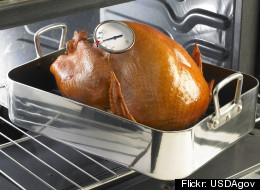
Turkeys must be kept at a safe temperature during "the big thaw." While frozen, a turkey is safe indefinitely. However, as soon as it begins to thaw, any bacteria that may have been present before freezing can begin to grow again.
 
A package of frozen meat or poultry left thawing on the counter more than 2 hours is not at a safe temperature. Even though the center of the package may still be frozen, the outer layer of the food is in the "Danger Zone" between 40 and 140 °F — at a temperature where foodborne bacteria multiply rapidly.
There are three safe ways to thaw food: in the refrigerator, in cold water, and in the microwave oven.

Safe Methods for Thawing
Immediately after grocery store checkout, take the frozen turkey home and store it in the freezer.
Frozen turkeys should not be left on the back porch, in the car trunk, in the basement, or any place else where temperatures cannot be constantly monitored.

Refrigerator Thawing
When thawing a turkey in the refrigerator:

    Plan ahead: allow approximately 24 hours for each 4 to 5 pounds in a refrigerator set at 40 °F or below.
    Place the turkey in a container to prevent the juices from dripping on other foods.


Refrigerator Thawing Times
Whole turkey:
    4 to 12 pounds — 1 to 3 days
    12 to 16 pounds — 3 to 4 days
    16 to 20 pounds — 4 to 5 days
    20 to 24 pounds —5 to 6 days
A thawed turkey can remain in the refrigerator for 1 or 2 days before cooking. Foods thawed in the refrigerator can be refrozen without cooking but there may be some loss of quality.

Cold Water Thawing
Allow about 30 minutes per pound.
First be sure the turkey is in a leak-proof plastic bag to prevent cross-contamination and to prevent the turkey from absorbing water, resulting in a watery product.
Submerge the wrapped turkey in cold tap water. Change the water every 30 minutes until the turkey is thawed. Cook the turkey immediately after it is thawed.

Cold Water Thawing Times
    4 to 12 pounds — 2 to 6 hours
    12 to 16 pounds — 6 to 8 hours
    16 to 20 pounds — 8 to 10 hours
    20 to 24 pounds — 10 to 12 hours

A turkey thawed by the cold water method should be cooked immediately. After cooking, meat from the turkey can be refrozen.

Microwave Thawing
Follow the microwave oven manufacturer's instruction when defrosting a turkey. Plan to cook it immediately after thawing because some areas of the food may become warm and begin to cook during microwaving. Holding partially cooked food is not recommended because any bacteria present wouldn't have been destroyed.

A turkey thawed in the microwave must be cooked immediately.

Saturday, November 15, 2014

Not doing anything today? Clean the Fridge!

Quick before the Holidays, give the 5DPT a whirl and avoid Holiday weight gain:
The 5 Day Pouch Test: Express Study Guide


Food Safety:
In the days and weeks leading up to the Winter high holidays we at the LivingAfterWLS Blog will be covering several food safety topics to keep you and those around your table healthy and well. After WLS it seems we become particularly sensitive to food illnesses so knowing how to prevent food borne illness and food contamination becomes paramount to our well being. I hope you will enjoy these features and take advantages of the many reliable resources we share here. Earlier this week we share a cool infographic and information for a safe and healthy Thanksgiving: Thanksgiving Food Safety


Today is a great time to continue the conversation: 
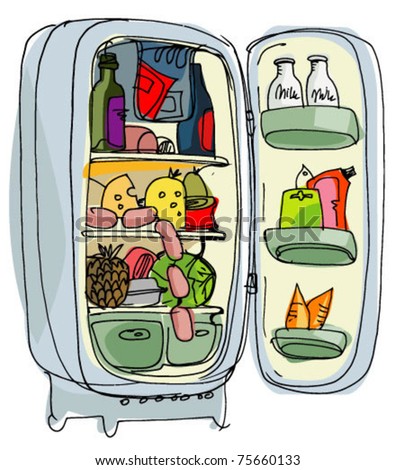
It is National Clean Out Your Refrigerator Day! 
Is your refrigerator giving you the stink eye?
Well - I'm getting the big ol' stink eye from the kitchen fridge and the basement fridge (better known around here as the "Island of Misfit Food!")  Lucky for me today is National Clean Out your Refrigerator Day! Yup! Who knew we had such a holiday?  Here's what I learned about it from the ever-so-informative website: Days of the Year
When : Always November 15th
Clean Out Your Refrigerator Day is today.

"What's that in the back of the refrigerator!? I don't want to find out. Don't open it...... the odor may overwhelm you!!! Hold your breath, scrunch your nose if you must, and get to the task.
Everything in your refrigerator was once a fresh, healthy food, ready for your consumption. It may have been a tasty leftover, intended for later enjoyment. Unfortunately, over the course of weeks or more, things get pushed to the back of the refrigerator and slowly transform into something impossible to identify. 


We've all run across items in the refrigerator that once were tasty food, But, now, they are some dried out, mold covered nasty, that you remove and dispose of at arms length. 


Who wins the prize for the worst refrigerator surprises? Most often, it's workplace refrigerators.


Use this day to clean out your refrigerator, top to bottom. When it comes to food safety, we fall back to the old saying  When in doubt, throw it out!"


Origin of Clean Out Your Refrigerator Day: We found references suggesting that Whirlpool Home Appliances was promoting Clean Out Your Refrigerator Day. However, we went to their website and performed a search of it. They make no mention of this day. 

Common speculation is that this day was created just in advance of Thanksgiving, to allow room for holiday leftovers. 

And here is a little refresher from the FDA on the good and proper method for going from stink to sweet as we mark this auspicious national holiday. Follow the link to the FDA for a print version to add to your Kitchen 411 Binder.

Food Safety: Removing Odors from Refrigerators and Freezers

                                 FDA Fact Sheet: Refrigerators and Freezers
Refrigerators and freezers are two of the most important pieces of equipment in the kitchen for keeping food safe. We are instantly reminded of their importance when the power goes off, flooding occurs, or the unit fails, causing food to become unsafe and spoil. The odors that develop when food spoils can be difficult to remove. Use this information to learn how to remove odors from units or how to safely discard an affected unit.
To Remove Odors from Refrigerators and Freezers
If food has spoiled in a refrigerator or freezer and odors from the food remain, they may be difficult to remove. The following procedures may help but may have to be repeated several times.

  • Dispose of any spoiled or questionable food.
  • Remove shelves, crispers, and ice trays. Wash them thoroughly with hot water and detergent. Then rinse with a sanitizing solution (1 tablespoon unscented, liquid chlorine bleach per gallon of water).
  • Wash the interior of the refrigerator and freezer, including the door and gasket, with hot water and baking soda. Rinse with sanitizing solution as above.
  • Leave the door open for about 15 minutes to allow free air circulation.
If odors remain, try any or all of the following:
  • Wipe inside of unit with equal parts vinegar and water. Vinegar provides acid which destroys mildew.
  • Leave the door open and allow to air out for several days.
  • Stuff both the refrigerator and freezer with rolled newspapers. Close the door and leave for several days. Remove paper and clean with vinegar and water.
  • Sprinkle fresh coffee grounds or baking soda loosely in a large, shallow container in the bottom of the refrigerator and freezer.
  • Place a cotton swab soaked with vanilla inside the refrigerator and freezer. Close door for 24 hours. Check for odors.
  • Use a commercial product available at hardware and housewares stores. Follow the manufacturer's instructions.
If Odors Cannot Be Removed
If odors cannot be removed, then the refrigerator or freezer may need to be discarded. If you need to discard the refrigerator or freezer, discard it in a safe manner:

  • "Childproof" old refrigerators or freezers so children do not get trapped inside. The surest way is to take the door off.
  • If the door will not come off, chain and padlock the door permanently and close tightly, or remove or disable the latch completely so the door will no longer lock when closed.
It is unlawful in many jurisdictions to discard old refrigerators or freezers without first removing the door. Depending on where you live, your appliance will be picked up by your solid waste provider, recyclers, a retailer (if you buy a new unit), or program sponsored by local or regional utilities.
Is this food still good?
Do you find yourself asking, "I wonder if this food item is still good?" or "How long will this keep in the refrigerator or freezer?" Check out this chart from FoodSafety, the USDA consumer resource site:
Storage times for the Refrigerator and Freezer

Wednesday, November 12, 2014

Retro-graphic: Thanksgiving Food Safety

FoodSafety.gov is the gateway to food safety information provided by government agencies. “The federal government will enhance www.foodsafety.gov to better communicate information to the public and include an improved individual alert system allowing consumers to receive food safety information, such as notification of recalls. Agencies will also use social media to expand public communications.”
Foodsafety.gov is a terrific site provided and produced by the United States Department of Agriculture. You cannot beat it as a resource for the most current information and guidance in keeping food safe and preventing foodborne illness. Bookmark foodsafety.gov as your go-to resource for reliable advice in all your food preparation.

Check out this retro-style infographic featuring Thanksgiving Food Safety Tips. Link Here for the full scale image on Flickr.


https://www.flickr.com/photos/40986460@N02/14895682412/in/set-72157646312506036


Get ready for the holidays - do the 5DPT now!
The 5 Day Pouch Test: Express Study Guide


Why Use a Food Thermometer?


Using a food thermometer is the only reliable way to ensure safety and to determine desired "doneness" of meat, poultry, and egg products. To be safe, these foods must be cooked to a safe minimum internal temperature to destroy any harmful microorganisms that may be in the food. "Doneness" refers to when a food is cooked to a desired state and indicates the sensory aspects of foods such as texture, appearance, and juiciness. Unlike the temperatures required for safety, these sensory aspects are subjective. (USDA Food Safety)


Wednesday, July 30, 2014

Refresher: Pork Cooking Temperatures

In 2011 the USDA lowered the internal cooking temperature for pork to 145 Fahrenheit much to the relief of many cooks who found the previous recommended temperature of 160 Fahrenheit overcooked. Many of us are enjoying pork during this grilling season so I'm re-publishing this press release from Pork Be Inspired as a refresher for properly cooked and safely handled pork. Be sure to click the link to download the free PDF chart from the USDA for a handy cooking reference.

Happy Grilling!
Kaye


For juicy, tender and flavorful pork, it might be time to toss out Grandma's advice. According to the new U.S. Department of Agriculture (USDA) guidelines, pork chops, roasts and tenderloins can be safely cooked to medium rare at a final internal cooked temperature of 145 degrees Fahrenheit as measured by a food thermometer, followed by a three-minute rest time.
pork_tenderloin 
The new cooking temperature will produce pork that's succulent and tender-not an over-cooked hockey puck - and will likely yield a finished product that is pinker in color than most of you are accustomed to. 

Restaurants have been following this standard for nearly 10 years. The new temperature recommendation reflects advances in both food safety and nutritional content for today's pork, which is much leaner than Grandma's, and even Mom's, pork. On average, the most common cuts of pork have 27 percent less saturated fat than the same cuts 20 years ago.

Both the USDA and the National Pork Board recommend using a digital cooking thermometer to ensure an accurate final temperature. Ground pork, like all ground meat, should be cooked to 160 degrees Fahrenheit. Pre-cooked ham can be reheated to 140 degrees Fahrenheit, or enjoyed cold on sandwiches.

In addition to the new lower cooking temperature recommendation for pork, the USDA food preparation guidelines advise the following:

· Clean: Wash hands and surfaces often
· Separate: Don't cross-contaminate
· Cook: To proper cooking temperatures
· Chill: Refrigerate promptly 

The National Pork Council has prepared a comprehensive easy to follow chart using the new USDA temperature guidelines. The download is free -- you don't even have to join their mailing list -- and I know you will find it to be a helpful resource in your kitchen.
Link: Be 145F Pork 

Tuesday, July 29, 2014

Safety Tips to Prevent Food Borne Illness This Summer

By Kaye Bailey As picnic and grilling season is upon us much of our focus is on enjoying warmer weather and outdoor dining. But now is also a good time to refresh our memories on food handling safety and illness prevention from food borne disease. We can take two approaches to protect our health from food illness: kitchen cleanliness and proper food storage and food preparation.

Kitchen Cleanliness: even in a spotless kitchen cross-contamination can occur. Good housekeeping practice means immediately washing anything that comes in contact with raw meat using a cleaning rag that is dedicated exclusively to clean-up of instruments and surfaces that have come in contact with raw meat or poultry. Some restaurants use pink dish rags for work in areas where raw meat is handled and white cloths in areas where cooked food is handled. It is wise to confine the handling of raw meat to as small of area as possible, such as the sink, and wipe down thoroughly after meat preparation.

A dilute mixture of warm water and chlorine bleach is an effective disinfectant for sterilizing surfaces where raw meat has been handled. For convenience keep on hand disinfecting wipes by Lysol or Clorox that kill 99% of bacteria. Use the wipes to clean counters and tools and then discard to avoid spreading bacteria and contamination from the cloth to other surfaces. I keep a spray bottle with 1/3-part chlorine to 2/3-parts water at hand to spray surfaces and wipe dry with paper toweling. Allow the chlorine mixture to set on the surface a few minutes before wiping clean and discarding the paper toweling.

Safe grilling ensures healthy summer dining.
Food Handling: Safe food handling begins at the time of purchase. In the best case meat or poultry will be used shortly after purchase, but if not should be stored between 28F and 32F in the meat compartment of the refrigerator. If the meat will not be used within two days it should be wrapped in a non-permeable plastic and stored in the freezer until use, but no longer than 6 to 12 months. Meat should only be thawed in the refrigerator, never at room temperature where bacteria, yeast, molds or viruses could develop.

E. coli is the best known of food borne bacteria and can live in meat and vegetables. In fact, any food can be contaminated with it: undercooked hamburger and roast beef, unpasteurized milk, unpasteurized cider processed from unwashed apples which fell on soil contaminated by the manure of sick cows, vegetables grown in soils fertilized with cow manure. There is no way a farmer, however careful and conscientious, can know which cow is contaminated and which is not. So it is up to the cook to prepare the foods they serve properly in accordance with safe food handling guidelines.

The US Department of Agriculture has prepared a list of Fahrenheit temperatures to which meat, poultry and eggs should be cooked in order to kill food borne bacteria. Temperatures should be measured with a clean instant-read thermometer inserted at the thickest part of the meat. Reference the table below:
  • Fresh ground beef, veal, lamb, pork: 160F
  • Beef, veal, lamb: roasts, steaks, chops: 145F (medium rare); 160F (medium); 170F (well done)
  • Fresh pork: roasts, steaks, chops: 145F
  • Ham: cook before eating: 160F
  • Ham: fully cooked, to reheat: 140F
  • Poultry: Ground chicken, turkey: 165F
  • Poultry: whole chicken, turkey: 180F
  • Poultry: breasts, roasts: 170F
  • Poultry: thighs & wings: cook until juices run clear
  • Stuffing: (cooked alone or in bird): 165F
  • Egg dishes, casseroles: 160F
  • Leftovers: 165F

For more information contact the USDA Meat and Poultry Hotline at 1-800-535-4555.

Fruits and Vegetables: Raw foods, such as produce, should be washed thoroughly under cool running water in an area free from contamination from raw meat preparation. Separate utensils and cutting boards should be used for produce and meat to avoid cross contamination.

Vegetables are best stored chilled to slow deterioration. Chilling of fruits and vegetables causes all metabolic activities, including respiration, to slow down. Most fruits and vegetables are best stored at refrigerator temperatures and in conditions where oxygen is limited. Store vegetables in the crisper compartment of the refrigerator, unwashed, until the time of use.

Friday, November 15, 2013

Is your refrigerator giving you the stink eye?

Well - I'm getting the big ol' stink eye from the kitchen fridge and the basement fridge (better known around here as the "Island of Misfit Food!")  Lucky for me today is National Clean Out your Refrigerator Day! Yup! Who knew we had such a holiday?  Here's what I learned about it from the ever-so-informative website: HolidayInsights.com

When : Always November 15th
Clean Out Your Refrigerator Day is today.

What's that in the back of the refrigerator!? I don't want to find out. Don't open it...... the odor may overwhelm you!!! Hold your breath, scrunch your nose if you must, and get to the task.
Everything in your refrigerator was once a fresh, healthy food, ready for your consumption. It may have been a tasty leftover, intended for later enjoyment. Unfortunately, over the course of weeks or more, things get pushed to the back of the refrigerator and slowly transform into something impossible to identify. 


We've all run across items in the refrigerator that once were tasty food, But, now, they are some dried out, mold covered nasty, that you remove and dispose of at arms length. 


Who wins the prize for the worst refrigerator surprises? Most often, it's workplace refrigerators.


Use this day to clean out your refrigerator, top to bottom. When it comes to food safety, we fall back to the old saying " When in doubt, throw it out!"


Origin of Clean Out Your Refrigerator Day: We found references suggesting that Whirlpool Home Appliances was promoting Clean Out Your Refrigerator Day. However, we went to their website and performed a search of it. They make no mention of this day. 

Common speculation is that this day was created just in advance of Thanksgiving, to allow room for holiday leftovers. 

And here is a little refresher from the FDA on the good and proper method for going from stink to sweet as we mark this auspicious national holiday. Follow the link to the FDA for a print version to add to your Kitchen 411 Binder.

Food Safety: Removing Odors from Refrigerators and Freezers

                                 FDA Fact Sheet: Refrigerators and Freezers
Refrigerators and freezers are two of the most important pieces of equipment in the kitchen for keeping food safe. We are instantly reminded of their importance when the power goes off, flooding occurs, or the unit fails, causing food to become unsafe and spoil. The odors that develop when food spoils can be difficult to remove. Use this information to learn how to remove odors from units or how to safely discard an affected unit.
To Remove Odors from Refrigerators and Freezers
If food has spoiled in a refrigerator or freezer and odors from the food remain, they may be difficult to remove. The following procedures may help but may have to be repeated several times.

  • Dispose of any spoiled or questionable food.
  • Remove shelves, crispers, and ice trays. Wash them thoroughly with hot water and detergent. Then rinse with a sanitizing solution (1 tablespoon unscented, liquid chlorine bleach per gallon of water).
  • Wash the interior of the refrigerator and freezer, including the door and gasket, with hot water and baking soda. Rinse with sanitizing solution as above.
  • Leave the door open for about 15 minutes to allow free air circulation.
If odors remain, try any or all of the following:
  • Wipe inside of unit with equal parts vinegar and water. Vinegar provides acid which destroys mildew.
  • Leave the door open and allow to air out for several days.
  • Stuff both the refrigerator and freezer with rolled newspapers. Close the door and leave for several days. Remove paper and clean with vinegar and water.
  • Sprinkle fresh coffee grounds or baking soda loosely in a large, shallow container in the bottom of the refrigerator and freezer.
  • Place a cotton swab soaked with vanilla inside the refrigerator and freezer. Close door for 24 hours. Check for odors.
  • Use a commercial product available at hardware and housewares stores. Follow the manufacturer's instructions.
If Odors Cannot Be Removed
If odors cannot be removed, then the refrigerator or freezer may need to be discarded. If you need to discard the refrigerator or freezer, discard it in a safe manner:

  • "Childproof" old refrigerators or freezers so children do not get trapped inside. The surest way is to take the door off.
  • If the door will not come off, chain and padlock the door permanently and close tightly, or remove or disable the latch completely so the door will no longer lock when closed.
It is unlawful in many jurisdictions to discard old refrigerators or freezers without first removing the door. Depending on where you live, your appliance will be picked up by your solid waste provider, a recycler, a retailer (if you buy a new unit), or program sponsored by local or regional utilities.

Monday, November 11, 2013

Trans-Fat: Four Must-Know Details From Recent FDA Determination

On November 7, 2013 the US Food and Drug Administration announced its preliminary  determination that partially hydrogenated oils (PHOs) are no longer classified as "Generally Recognized as Safe" (or GRAS*). Not only did the FDA say the PHOs are not GRAS, they determined that trans fats have "significant adverse health effects." 

Partially hydrogenated oils are the primary source of trans fat in the food supply. Partially hydrogenated oils are formed during food processing when hydrogen is added to vegetable oil to make it more solid. Partially hydrogenated oils are used by food manufacturers to improve the texture, shelf-life and flavor stability of foods.  

The FDA's preliminary determinations is based on scientific evidence that shows consumption of trans fat raises low density lipoprotein --LDL-C or "bad"-- cholesterol, which increases the risk of developing heart disease. Further evidence supports the belief that eliminating trans fat from partially hydrogenated oils could prevent up to 20,000 cases of coronary heart disease and up to 7,000 deaths annually.

Four things to know about Trans Fat

("Quoted" responses provided by the FDA Questions & Answers about Trans Fat)

1. What foods contain trans fat?
"Partially hydrogenated oils, and therefore trans fat, can be found in baked goods such as cakes, cookies and pies; snack foods such as microwave popcorn; frozen pizza; some fast food; margarine and other spreads, coffee creamer; vegetable shortenings and stick margarines; and refrigerator dough products such as biscuits and cinnamon rolls."


2. Does trans fat contribute to obesity?
"Reducing trans fat intake is more about cardiovascular health than obesity. Even individuals who maintain a healthy weight are susceptible to cardiovascular diseases. It is well accepted that trans fat consumption contributes to heart disease, the leading cause of death in the U.S. Today’s action is an important step toward addressing factors that contribute to everyone’s cardiovascular disease risk."

Kaye's Note: Although trans fat is not implicated in causing obesity, the foods that most likely contain trans fat are not appropriate in the weight loss surgery high protein diet and are unlikely to support or contribute to successful weight management.
3. Do I need to eliminate trans fat from my diet?
"The independent Institute of Medicine (IOM) has concluded that trans fat provides no known health benefit and that there is no safe level of consumption of artificial trans fat. Additionally, the IOM recommends that consumptions of trans fat should be as low as possible while consuming a nutritionally adequate diet. Further, the 2010 Dietary Guidelines for Americans recommends that individuals keep consumption of trans fat as low as possible."

Kaye's Note: Again, since trans fat is most commonly found in processed foods that do not support our WLS diet we should mindfully reduce or eliminate them from our diet in support of improved health and our weight management goals with bariatric surgery.
4. How do I know if there is trans fat or PHO's in my food?
"Consumers should look at both the trans fat level on the Nutrition Facts label and the ingredient list. Since 2006, the FDA has required that trans fats be declared on the Nutrition Facts label of foods. Products listed as “0 g trans fat” contain 0 to less than 0.5 g/serving trans fats. This means that foods labeled “0 g trans fat” may still contain some artificial trans fat. The ingredient list will provide information on whether the product contains partially hydrogenated oils."


*FDA Definition: Generally Recognized as Safe (GRAS)

"GRAS" is an acronym for the phrase Generally Recognized As Safe. Under sections 201(s) and 409 of the Federal Food, Drug, and Cosmetic Act (the Act), any substance that is intentionally added to food is a food additive, that is subject to premarket review and approval by FDA, unless the substance is generally recognized, among qualified experts, as having been adequately shown to be safe under the conditions of its intended use, or unless the use of the substance is otherwise excluded from the definition of a food additive.


Thursday, August 01, 2013

Beef Recall & Food Handling Safety

For the second day in a row our concern turns to food safety. The USDA announced Wednesday the recall of 50,000 pounds of ground beef due to possible E. coli contamination. Here is the report from USA Today:

From USA Today:
Kansas firm recalls 50,000 pounds of raw ground beef

A Kansas company has recalled approximately 50,000 pounds of ground beef that may be contaminated with E. coli O157:H7, the U.S. Department of Agriculture announced Wednesday.

No illnesses have been reported linked to the consumption of the meat, which was produced by National Beef Packing Company of Liberal, Kan.

The beef was sold in 40 to 60 pound cases to retailers, wholesalers, and food service distributors nationwide, USDA's Food Safety and Inspection Service said in a release. The product carries the establishment number "EST. 208A" Inside the USDA mark of inspection.

Where the meat was sold at the retail and wholesale level is unknown.

E. coli O157:H7 is a potentially deadly bacteria that can cause bloody diarrhea, dehydration, and in severe cases, kidney failure. It is considered an adulterant in raw beef.

National Beef recalled 22,737 pounds of raw ground beef on June 18, also due to possible contamination with E. coli O157:H7.


Safe Handling of Beef 4 Page Bulletin
A scare like this is always a good time to brush-up on our food handling skills. Clemson University Cooperative Extension has prepared a comprehensive bulletin on meat handling safety. Print the downloadable PDF bulletin to include in your Kitchen 411 Binder. This brief section on ground beef is taken from that publication:

Ground Beef: Ground beef must be cooked thoroughly to kill harmful bacteria. Unlike whole muscle meat, whose interior meat is sterile, the grinding process exposes the interior meat in ground beef to bacteria, which may be on the surface, in the air, on equipment or on people's hands. To kill these bacteria, food safety experts have one major rule of thumb—cook ground beef (including hamburgers and ground beef mixtures such as meat loaf) to at least 155 °F. This step, while very simple, offers the best protection that consumers can have for serving ground beef products safely.

Wednesday, July 31, 2013

Nice Graphic: CDC Food Safety Free Download


Here is another very good food safety PDF from the Centers for Disease Control. Great resource for your Kitchen 411 binder. Use the link below to connect to the download graphic:

"Steps to Safe and Healthy Fruits & Vegetables from the CDC
"From the Store to Your Table. Fruits and vegetables are healthy to eat. But did you know that harmful germs, like Salmonella, E. coli, and Listeria, can sometimes be on fruits and vegetables. There are steps that can help keep you healthy - and your fruits and vegetables safer to eat -- from the store to your table."


Get the printable infograph: CDC Food Safety

Bag Salad Implicated in Illness Outbreak

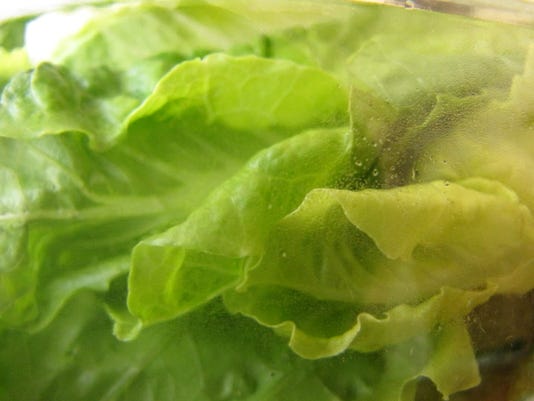
I saw the news about the same time I was preparing our family dinner that included a salad of fresh greens straight from the bag: Bag Salad Implicated in Illness Outbreak. Like many hungry Americans preparing the evening meal I took pause to consider the implications of serving my safe and easy bagged salad.

What is the risk? Should we take our chances and hope our salad was safe to eat? Who can you trust regarding food safety? And what the heck is Cyclospora?

Here's a segment of the USA Today report on August 30:

"An outbreak of a diarrheal disease that has sickened 372 people in 15 states since June may be linked to a bagged salad mix.

"The evidence points to a salad mix containing iceberg and romaine lettuce, as well as carrots and red cabbage, as the source of the outbreak reported in Iowa and Nebraska," Steven Mandernach, chief of the Food and Consumer Safety Bureau of the Iowa Department of Inspections and Appeals, said in a release Tuesday.

"The investigation by Iowa and Nebraska health officials found that at least 80% of people in those states infected in the cyclospora outbreak had eaten a prepackaged salad mix.

"A seven-person Food and Drug Administration team has begun a trace-back investigation to identify where the ingredients in the salad mix came from.

"Cyclospora is an intestinal illnesses caused by the microscopic parasite Cyclospora cayetanensis. It is transmitted when feces enter the food or water supply and are consumed. The disease causes watery and sometimes explosive diarrhea and is treated with antibiotics. Symptoms can also include fatigue, anorexia, bloating, stomach cramps, vomiting, muscle aches and a low fever.

"Cases have been reported in Arkansas, Connecticut, Florida, Georgia, Illinois, Iowa, Kansas, Minnesota, Missouri, Nebraska, New Jersey, New York, Ohio, Texas and Wisconsin. Health officials do not know whether all the reported cases are part of the same outbreak."
Neither state nor federal agencies have named the manufacturer or salad mix that was contaminated with the cyclospora. It is safe to expect that most salads contaminated have expired and should be discarded (the contamination dates back to June 28, 2013).

For consumers the first act of caution should be discarding any expired packaged produce. When shopping always check expiration dates and be certain the produce you purchase has been refrigerated. Experts generally agree that salads labeled "washed" or "triple-washed" do not need to be washed again at home.

The Food Safety and Nutrition Department at Clemson University addresses the issue of safe handling of lettuce and leafy greens in a 2012 publication. They advise:
Ready to Eat” Lettuce/Leafy Green Salad
If a “ready to eat” lettuce or leafy green salad is received in either a sealed bag or rigid plastic container labeled "washed", "triple washed" or "ready-to-eat" it does not need additional washing before you eat it unless specifically directed on the label. Washing ready-to-eat green salads is not likely to enhance safety. Furthermore, the risk of cross contamination from handling and food contact surfaces may outweigh any safety benefit that further washing may have.

If you choose to wash “ready to eat” lettuce or salad before use, wash your hands thoroughly with soap and warm water for at least 20 seconds before handling and rewash hands as necessary. Clean the sink, colander, salad spinner and any utensils that will contact the lettuce with hot soapy water. Use cold running water to wash lettuce/leafy green salads to reduce the potential for cross contamination. Dry in a clean salad spinner or wipe dry with a paper towel that has not been previously used for another purpose."
Clemson has provided the full text of this two-page publication in a convenient downloadable PDF for reference in your own kitchen. Link below:

Download the PDF


Tuesday, November 20, 2012

Holiday Hotlines - Cooking help just a call away


For those of you asking - here is the link to last week's LivingAfterWLS Digest - and the list of hotline numbers for cooking questions and emergencies. Keep this at hand ----just in case you run into questions or problems while fixing your Thanksgiving meal. Be safe and Enjoy!

Helpful Cooking Hotlines


To see the full digest go here: LivingAfterWLS Digest Nov 15

Monday, December 19, 2011

Citrus Guidelines from USDA - Good to Know

Good to Know - a few things about citrus to keep us healthy this giving season. From the United States Department of Agriculture:

Giving Citrus this Holiday Season? Four Things You Need to Know

If you are looking to give a thoughtful, healthy gift this holiday season, citrus is the way to go. But beware of infected citrus fruit and plants, especially if you plan to buy citrus online.
Before you give citrus, here are four things you should know:
  1. Be Aware of Quarantines. If you are thinking about giving citrus fruit, plants, or items made with citrus (such as floral arrangements, wreaths, potpourri or seasonings like kaffir lime leaves), be sure not to move them from quarantined states or territories. Not only are you risking spreading citrus diseases by transporting citrus outside of these areas, but it’s also against the law. Review the quarantine map.
  2. Check the Citrus Supplier. Be a savvy buyer. Gift citrus fruit sold in a regulated state must be packed in a certified packinghouse and accompanied by a USDA certificate. Commercial fruit packers, Internet shippers and roadside vendors within regulated states should be able to prove they are in compliance with the federal quarantine. Before you buy, ask the vendor if their product is in compliance. Review the quarantine map.
  3. Keep Homegrown Citrus at Home. Help reduce the spread of citrus diseases by not moving your homegrown citrus fruit or plants across state lines. Enjoy your fruit with friends and neighbors, but be sure to obtain a federal certificate if you’re thinking of transporting your citrus outside of your state. To inquire about transporting your citrus out of state, contact your USDA State Plant Health Director’s office.
  4. Avoid Fines and Penalties. Because citrus diseases have destroyed millions of acres of citrus around the world, they present an immediate and urgent threat to America. If you knowingly purchase citrus in violation of quarantine regulations and requirements, the penalties you could incur range from $1,100 to $60,000 per violation. If you suspect citrus is being moved improperly, report your concerns to USDA’s Smuggling Interdiction and Trade Compliance toll-free hotline at (800) 877-3835.
To learn more, follow the 12 Days of Citrus on facebook.com/saveourcitrus and twitter.com/saveourcitrus, or visit our website.

Wednesday, March 17, 2010

Corned Beef & Food Safety

Happy St. Patrick's Day! Many of us will be preparing and serving corned beef in celebration of St Patrick's Day today. As a quick refresher here is the US Department of Agriculture's Fact Sheet on Corned Beef and Food Safety. Make sure you are familiar with all safety measures to avoid any unpleasant food incidents that would disrupt your celebrations! Have a great day!


Corned Beef and Food Safety

For USDA's Meat and Poultry Hotline, the approach of spring usually means that St. Patrick's Day dinner preparations across the country will spark many questions about the safe handling, storage and preparation of corned beef and all the trimmings. But food safety involves more than the "luck of the Irish."

What is "corning"?
Corning is a form of curing; it has nothing to do with corn. The name comes from Anglo-Saxon times before refrigeration. In those days, the meat was dry-cured in coarse "corns" of salt. Pellets of salt, some the size of kernels of corn, were rubbed into the beef to keep it from spoiling and to preserve it.

Today brining—the use of salt water—has replaced the dry salt cure, but the name "corned beef" is still used, rather than "brined" or "pickled" beef. Commonly used spices that give corned beef its distinctive flavor are peppercorns and bay leaf. Of course, these spices may vary regionally.

Package Dating and Storage Times
Uncooked corned beef in a pouch with pickling juices which has a "sell-by" date or no date may be stored 5 to 7 days in the refrigerator, unopened. Products with a "use-by" date can be stored unopened in the refrigerator until that date.

Drained and well wrapped, an uncooked corned beef brisket may be frozen for 1 month for best quality. It's recommended to drain the brine because salt encourages rancidity and texture changes. The flavor and texture will diminish with prolonged freezing, but the product is still safe. After cooking, corned beef may be refrigerated for about 3 to 4 days and frozen for about 2 to 3 months for best quality.

Preparation
Corned beef is made from one of several less tender cuts of beef like the brisket, rump or round. Therefore, it requires long, moist cooking. Keep food safety in mind when preparing corned beef. It can be cooked on top of the stove or in the oven, microwave or slow cooker.

Corned beef may still be pink in color after cooking. This does not mean it is not done. Nitrite is used in the curing process. This fixes pigment in the meat and affects the color.

Allow the brisket to stand for about 10 minutes after removing from the heat. This will make it easier to slice, and it is best sliced diagonally across the grain of the meat.

Cooking
The USDA does not recommend one particular cooking method as best. Following are methods from various sources. The cooking times are based on corned beef that is not frozen at the time of cooking. "Fork-tender" is a good indication of doneness, but use a food thermometer to be sure. For tenderness and texture, cook until the corned beef reaches a safe minimum internal temperature of 160 °F or above.
  • OVEN: Set the oven for 350 °F or no lower than 325 °F. Place brisket fat-side up. Barely cover the meat with water—about 1 inch—and keep the container covered throughout the cooking time. Allow about 1 hour per pound.
  • STOVE: Place brisket fat-side up in a large pot and cover it with water. Bring the water to a boil; then reduce the heat and simmer, allowing about 1 hour per pound. Vegetables may be added during the last 20 to 30 minutes of cooking. Cook vegetables to desired tenderness.
  • SLOW COOKER: If using root vegetables, such as potatoes and carrots, put them in the bottom of slow cooker. Place brisket on top of vegetables (if using) or in bottom of cooker. Add about 1-1/2 cups of water or enough to cover meat. Cover and cook on high setting for the first hour of cooking. Then cook for 10 to 12 hours on the low setting or 5 to 6 hours on high. Cabbage wedges may be added on top of the brisket during the last 3 hours of cooking.
  • MICROWAVE: Calculate cooking time at 20 to 30 minutes per pound. Place brisket in a large casserole dish and add 1-1/2 cups of water. Cover with lid or vented plastic wrap and microwave on medium-low (30 percent power) for half the estimated time. Turn meat over and rotate dish. Microwave on high for remainder of time or until fork tender. Vegetables may be added during the final 30 minutes of cooking.

Cooking Ahead
Some consumers prefer to cook corned beef ahead of time. It is easier to cut uniform slices when corned beef is cold. Cooking ahead also makes it easier to reheat and serve
later.

After cooking a whole corned beef, cut it into several pieces for faster cooling—or slice it, if you like. Place the beef in small, shallow containers and cool it in the refrigerator quickly.

Leftovers
Any corned beef left over from a meal should be refrigerated promptly—within 2 hours of cooking or reheating. Use cooked-ahead or leftover corned beef within 3 to 4 days or freeze 2 to 3 months.

Monday, October 12, 2009

Food Borne Disease: Refresher Course

As cold and flu season is upon us much of our focus is on preventing just that: colds and flu. But now is also a good time to refresh our memories on food handling safety and illness prevention from food borne disease. We can take two approaches to protect our health from food illness: kitchen cleanliness and proper food storage and food preparation.

Kitchen Cleanliness: even in a spotless kitchen cross-contamination can occur. Good housekeeping practice means immediately washing anything that comes in contact with raw meat using a cleaning rag that is dedicated exclusively to clean-up of instruments and surfaces that have come in contact with raw meat or poultry. Some restaurants use pink dish rags for work in areas where raw meat is handled and white cloths in areas where cooked food is handled. It is wise to confine the handling of raw meat to as small of area as possible, such as the sink, and wipe down thoroughly after meat preparation.

A dilute mixture of warm water and chlorine bleach is an effective disinfectant for sterilizing surfaces where raw meat has been handled. For convenience keep on hand disinfecting wipes by Lysol or Clorox that kill 99% of bacteria. Use the wipes to clean counters and tools and then discard to avoid spreading bacteria and contamination from the cloth to other surfaces. I keep a spray bottle with 1/3 chlorine to 2/3's water at hand to spray surfaces and wipe dry with paper toweling. Allow the chlorine mixture to set on the surface a few minutes before wiping clean and discarding the paper toweling.

Food Handling: Safe food handling begins at the time of purchase. In the best case meat or poultry will be used shortly after purchase, but if not should be stored between 28F and 32F in the meat compartment of the refrigerator. If the meat will not be used within two days it should be wrapped in a non-permeable plastic and stored in the freezer until use, but no longer than 6 to 12 months. Meat should only be thawed in the refrigerator, never at room temperature where bacteria, yeast, molds or viruses could develop.

E. coli is the best known of food borne bacteria and can live in meat and vegetables. In fact, any food can be contaminated with it: undercooked hamburger and roast beef, unpasteurized milk, unpasteurized cider processed from unwashed apples which fell on soil contaminated by the manure of sick cows, vegetables grown in soils fertilized with cow manure. There is no way a farmer, however careful and conscientious, can know which cow is contaminated and which is not. So it is up to the cook to prepare the foods they serve properly in accordance with safe food handling guidelines.

The US Departement of Agriculture has prepared a list of Farenheit temperatures to which meat, poultry and eggs should be cooked in order to kill foodborne bacteria. Temperatures should be measured with a clean instant-read thermometer inserted at the thickest part of the meat. Reference the table below:

Fresh ground beef, veal, lamb, pork: 160F
Beef, veal, lamb: roasts, steaks, chops: 145F (medium rare); 160F (medium); 170F (well done)
Fresh pork: roasts, steaks, chops: 160F (medium); 170F (well done)
Ham: cook before eating: 160F
Ham: fully cooked, to reheat: 140F
Poultry: Ground chicken, turkey: 165F
Poultry: whole chicken, turkey: 180F
Poultry: breasts, roasts: 170F
Poultry: thighs & wings: cook until juices run clear
Stuffing: (cooked alone or in bird): 165F
Egg dishes, casseroles: 160F
Leftovers: 165F

For more information contact the USDA Meat & Poultry Hotline at 1-800-535-4555.

Fruits and Vegetables: Raw foods, such as produce, should be washed thoroughly under cool running water in an area free from contaimination from raw meat preparation. Separate utensils and cutting boards should be used for produce and meat to avoid cross contamination.

Vegetables are best stored chilled to slow deterioration. Chilling of fruits and vegetables causes all metabolic activities, including respiration, to slow down. Most fruits and vegetables are best stored at refrigerator temperatures and in conditions whree oxygen is limited. Store vegetables in the crisper compartment of the refrigerator, unwashed, until the time of use.

Saturday, January 31, 2009

Salmonella Peanut Recalls: Expect More

Many people who have undergone surgical weight loss supplement their diets with protein shakes and bars. We could be affected by the salmonella recall for peanut butter products. Read what WebMD is reporting about this health scare:

Salmonella Peanut Recalls: Expect More
No End in Sight to Peanut Product Recalls Spurred by Salmonella Outbreak; Criminal Probe Under Way
By Miranda Hitti
WebMD Health News
Reviewed by Louise Chang, MD


Jan. 30, 2009 -- More recalls and a criminal investigation are the latest news in the salmonella outbreak linked to the Peanut Corporation of America's processing plant in Blakely, Ga.

More than 400 peanut products have been recalled in the wake of the outbreak. Those items are listed in the FDA's searchable list of recalled products. That list is expected to keep growing, so FDA officials encourage consumers to check it regularly. Companies that have recently announced new or expanded peanut butter recalls include:

Arico Natural Foods Company is recalling Arico Peanut Butter Cookies and Cookie Bars.

Orchard Valley Harvest is recalling certain conventional and organic peanuts roasted and packed for Safeway.

Country Maid Inc. has expanded its recall of 2-pound packages of Classic Breaks Peanut Butter Cookie Dough.

Hy-Vee Inc. is recalling its freshly made party mix and peanut brittle sold at Hy-Vee stores in Iowa, Illinois, Missouri, Kansas, Nebraska, South Dakota, and Minnesota.

Meijer is recalling Meijer Bulk Dry Roasted Peanuts, Markets of Meijer Dry Roasted Peanuts, Meijer Vanilla Sundae Cone w/Peanuts, and Meijer Fudge Sundae Cone w/Peanuts.

Fieldbrook Foods Corp. is recalling ice cream sundae cone products that contain granulated peanuts from PCA. This recall includes more than 80 products sold under the brands America's Choice, Artic Classic, Big Y, Bon, Byrn Dairy, Carnival, Cub Foods, Dolly Madison, Econo, Food Club, Flavorite, Food City, Giant Eagle, Giant, Grande, Greens, Hill Country Fare, Hagan, Hood, Ice Girl, IGA, Kay's Key Food, Krasdale, Lowes, Market Basket, Meijer, Pathmark, Price Chopper, Pricerite, Publix, River Valley, Redners, Richfood, Roundy's, Shop 'n Save, Shoprite, Shurfine, Shurfresh, Stater Bros, Stop & Shop, Sundae Shoppe, Tops, United Dairy, Valu Time, Velvet, Weis, and Winn Dixie.

Wells' Dairy Inc. is recalling all Blue Bunny No Sugar Added Reduced Fat Bunny Tracks Ice Cream with "Best Used By" dates prior to Jan. 29, 2009, and one lot of Blue Bunny Personals Bunny Tracks with a "Best Used By" date of 09/11/09.

Wegmans Food Markets Inc. is recalling its peanut covered doughnuts (sold individually), peanut butter cookies (sold by the pound only in Wegmans stores with a full-service cookie shop), and chocolate peanut butter tarts (sold only in Wegmans stores with a full-service patisserie).

If you know someone without Internet access, they can call the CDC at 800-CDC-INFO and a staff member will search the FDA's database for them.

At least 529 people in 43 states and a person in Canada have been sickened by the outbreak strain of Salmonella Typhimurium. The outbreak may have contributed to at least eight deaths, according to the CDC.

Read More on WebMD