LAWLS Bookstore

Showing posts with label diet after weight loss surgery. Show all posts

Thursday, May 18, 2017

Inspired Reminders Bulletin: Your Body is Fighting You!

Greetings Dear Readers!
The May LivingAfterWLS Inspired Reminders newsletter was published and delivered to your Inbox today. Be sure to check it out, it is full of useful information you need to know in your WLS journey. Here is the introduction and if you are not subscribed you can can read it here in our online archive: LivingAfterWLS May Inspired Reminders Bulletin

Link here to join our free mailing list: LivingAfterWLS Privacy Guaranteed Subscriber Form

It's not your imagination!

Your body is fighting against weight loss.   
 
The chills & thrills of weight loss surgery.

In 2009 I wrote, "Ten years after being gut-whacked and I'm still on a diet." That is what I wanted to title my book which was eventually published as "Day 6: Beyond the 5 Day Pouch Test." In the introduction I explained, "No matter what treatment a person with the disease of morbid obesity seeks there is a tough journey to follow. There is no "easy way out." I am still on a diet. And it doesn't look to change anytime soon."

Jump forward to spring 2017: I'm 18-years removed from surgery and I'm still on a diet! I guess I'm in it for life. At one time this realization would have scared the jelly out of my doughnut. But these days it's my security blanket. I know I have a disease: obesity. I have been surgically treated for the disease. By following the prescribed lifestyle plan including diet and exercise I can work with my surgery to keep the disease in remission. That is the cold hard reality for all of us living after WLS. (See the article below Obesity Reclassified from 2013 when the AMA official categorized obesity a disease.)

Mind you, this acceptance was not easily achieved. I rebelled with vigor against the rules abandoning diet and physical activity in favor of hoping for the best. Leaving things to chance, however, did not help me control my obesity before surgery or after surgery. In our WLS community the path commonly trends to complete compliance following surgery followed by a detour along the road to chance and then, hopefully, a calm resolve of acceptance and renewed commitment to the lifestyle that supports our health and weight management goals. I've observed this trend for a decade and the anecdotal evidence predicts most patients will experience this learning curve.

Today's Bulletin features a look at why our body resists weight loss in the feature article It's not your imagination! Your body is fighting everything you do to lose weight. I found this subject revealing. I hope you enjoy it. As mentioned above you will find information about the 2013 obesity classification and also a primer Obesity Defined. Be sure to check out our Recipe: Tuna Pasta Primavera and then link through to some of the reader favorite Hot Blog Topics of the last few weeks.

I appreciate your time today, I know your Inbox is loaded with messages needing your attention. May I also take this opportunity to thank those who support our LivingAfterWLS Bookstore and other publication outlets. The LivingAfterWLS research work is self-funded and it is through your support that we are able to conduct clean research without becoming prejudiced by sponsors expecting a quid pro quo return of favorable findings in exchange for funding. Have a fabulous week and may good health be yours to enjoy!

Link to Bulletin

Kaye Bailey

Friday, December 07, 2012

Holiday Foods that Derail Weight Loss Goals

The Naughty List of Holiday Food from WebMD


This 15-slide WebMD presentation takes a quick look at holiday foods that may derail our best weight management efforts. Now, you know me well enough to know I don't care to assign food moral attributes such a "naughty" or "nice" -- food is food. Removing the moral labels gives us a more rationale attitude about the things we select to provide nutrition.  With that in mind, take a look at these foods which may not support our nutritional and weight management goals.

For holiday recipes that support our weight loss surgery health goals take a look at these two "Cooking with Kaye" email newsletters from our archive.

Classic Cooking with Kaye: Recipes we Love Year After Year

Cooking with Kaye: New Classics to Love


Friday, November 16, 2012

Beyond the Plate at Thanksgiving

Now Online: Weekly Digest
Feasting Season: The Bigger Picture Beyond the Plate

Thank you for joining me for this Weekly Digest. As we are nearing Tha
nksgiving Day and the feasting season of the next several weeks today the Digest takes a look at the greater picture of our feasting traditions. I hope you will find our feature article insightful. As I researched the traditions and customs of food gatherings I came to understand that these big holiday meals symbolize community and human experience beyond the individual plate. While the feasting can feel overwhelming to us after bariatric surgery we can find ways to participate as part of the group while meeting our individual needs and restrictions. Feature Article. And while the feasting traditions continue, newer traditions present opportunities beyond the table. Take a look at the Turkey Quest article and tool to help us find charitable and volunteer opportunities in which to participate. And finally, in homage to the ubiquitous pumpkin I share a cookie recipe from Diabetic Living. Make and share these delicious cookies this week and feel good about contributing a healthy option to your holiday menu.

HOTLINES!
As the holiday nears we have gathered some terrific hotline resources for your cooking questions and emergencies including Butterball Turkey Talk and the US Department of Agriculture. Keep this reference list at hand ... just in case.

Thank you again for joining me, remember, We are ALL in this together. I wish you and the people you celebrate with a happy and healthy Thanksgiving.

Cheers!
Kaye Bailey
 

Saturday, July 10, 2010

Summer Soups - A Healthy Choice For Weight Loss Surgery Dieters

By Kaye Bailey

Summer is a time of abundant vegetables available locally grown at affordable prices. Through the hot summer and into fall farm stands dot America's byways as local growers bring to the public an abundance of freshly grown vegetables, fruits and berries. People who control their weight with bariatric weight loss surgery (WLS) can benefit from a stop at the farm stand for fresh vegetables to transform into healthy soup.

A recent study from Pennsylvania State University indicates that people who include a daily serving of soup in their diet are more likely to lose weight and maintain a healthy weight than those who do not enjoy soup in their diet. A homemade vegetable soup is considered a low-energy-density food that is rich in fiber, vitamins, and nutrients. It is "low-energy" because the calories (energy) in the food are low in comparison to the volume of the food. For example, a 1-cup serving of vegetable soup is seldom more than 100 calories, depending on the amount of fat used in preparation. On the other hand a 1 cup serving of ice cream contains 300 calories making it a high-energy-density food with little nutritional value.

The study found that soup as a first course, or a mid-morning or mid-afternoon snack, is filling to the point that further calorie consumption through the day decreases. It is believed that soup helps sustain satiation because the fiber from vegetables slows digestion. In addition, carbohydrates from homemade vegetable soup tend to be low-glycemic and do not adversely affect glucose response in the same way simple processed carbohydrates do. As a result our metabolic process is steady and we do not feel an energy surge or drop that is often experienced when eating simple carbohydrates.

Many weight loss surgery patients who complain of "carb-cravings" find that eating a 1-cup serving of soup is an effective way to stop those cravings and curtail feelings of "head-hunger." People who feed "head-hunger" with simple processed carbs tend to eat significantly more calories without satiating those cravings. This eventually leads to weight gain, even after weight loss surgery.

A good homemade vegetable soup can be put together quickly and keeps for up to a week refrigerated. Consider soup making as a series of layers, starting with savory onions and garlic. Heat a healthy monounsaturated fat such as olive oil or peanut oil over medium heat. Add one chopped onion and a clove of minced garlic and cook and stir until soft and translucent. While the onion and garlic cook wash and chop the vegetables for your soup. Select fresh seasonal vegetables that are crisp and unblemished. Vegetables that are good in summer soup include zucchini and summer squash, fresh tomatoes, green beans, carrots, turnips, spinach, napa cabbage, green onions, and fresh herbs. Fill the soup pot with as many fresh vegetables as you like, add the herbs during the final minutes of cooking.

For liquid add low-sodium chicken or vegetable broth, tomato juice, or seasoned vegetable juice such as V8 diluted with water. Simmer the vegetables and liquid just until the vegetables are tender and flavors combine. For weight loss surgery patient a thick soup is desired to provide a denser meal and avoid a "slider food" that slips through the stomach pouch too quickly. Portions should be carefully measured at 1-cup per serving and this should be eaten in 15 minutes or less. Taking longer to eat soup will result in greater consumption and a decreased feeling of fullness.

In general, a 1 cup serving of vegetable soup will provide 3 grams of protein and 15 grams of healthy carbohydrate in addition to fiber and beneficial phytonutrients including vitamins, minerals, and antioxidants. While our dietary focus with weight loss surgery is to eat a high protein diet, a freshly made vegetable soup is a healthy nutritional compliment to that diet. Vegetables are known to lower the risk of many cancers, heart disease and stroke and strengthen the immune system. For many with weight loss surgery raw vegetables or salads may cause gastric distress, but most WLS patients report a high tolerance for vegetable soup.

Kaye Bailey (c) - All Rights Reserved

For more terrific weight loss surgery friendly recipes link to LivingAfterWLS Kitchen


Join the LivingAfterWLS Neighborhood: Your safe haven circle of friends making the most of their weight loss surgery experience. LivingAfterWLS Neighborhood


Article Source: Summer Soups - A Healthy Choice For Weight Loss Surgery Dieters

Thursday, July 01, 2010

Dark Meat Chicken and the High Protein WLS Diet

By Kaye Bailey

Chicken legs and chicken thighs are often left behind by those following the weight loss surgery high protein diet who favor the leaner lighter breast meat. For years dark meat poultry has been rejected by dieters as too high in fat to play a beneficial role in a healthy weight management lifestyle. But this nutrient dense meat has a place in the bariatric diet and in these difficult economic times dark meat poultry is an affordable choice at the market.

A 3-ounce serving of dark meat chicken, skin removed, provides 166 calories, 21 grams protein, 8 grams of fat (2 grams saturated) and 76mg of cholesterol. But meat should not be judged on its nutritional profile alone: dark meat poultry is an excellent source of the B vitamins niacin and riboflavin and a good source of zinc. And bundle packages of chicken drumsticks and thighs are ridiculously affordable too, often priced less than $1 a pound. Many nutritionists say that the benefits of the nutrient dense dark meat make it the preferred choice to white meat poultry provided the skin is removed before eating and a low-fat cooking method is used to prepare the chicken.

Weight loss surgery patients are prone to B vitamin deficiencies. In addition to B vitamin supplementation patients should regularly include foods that are rich in B vitamins in their diet. Niacin, vitamin B3, is important in the body's production of energy from food. Niacin helps keep the skin, nerves, and digestive system healthy and is required for normal growth and the synthesis of DNA. Riboflavin, vitamin B2, plays an essential role in the production of red blood cells, energy production, and growth. As we age it is believed we do not consume enough riboflavin and may become deficient in this important B vitamin.


Learn more about B Vitamins & WLS

At the market look for chicken thighs and drumsticks packaged separately. Thighs are available boneless and bone-in. My favorite piece is the whole chicken leg with the thigh and drumstick intact and the skin on. Ten-pound bags of chicken legs are available at most super-stores for around.75 cents a pound, a fine bargain when feeding a crowd. Chicken legs can be seasoned and roasted in the oven, skillet fried, or grilled outdoors. Poultry should be cooked to an internal temperature of 165 degrees Fahrenheit. A meat thermometer is the best method for testing chicken for doneness. Without a thermometer to test for doneness pierce the skin and meat with a sharp knife or skewer allowing juices to run. If the juices run clear the meat is cooked.

Serve dark meat poultry with fresh vegetables and citrus fruit. When eaten with poultry, citrus fruits, cabbage, broccoli, red bell peppers, kale, strawberries, kiwifruit will enhance iron absorption from the poultry thus promoting overall health and wellness.

Kaye Bailey (c) - All Rights Reserved

For more terrific weight loss surgery friendly recipes link to LivingAfterWLS Kitchen

Join the LivingAfterWLS Neighborhood: Your safe haven circle of friends making the most of their weight loss surgery experience.LivingAfterWLS Neighborhood

Article Source:  Dark Meat Chicken and the High Protein Weight Loss Surgery Diet

Tuesday, May 18, 2010

Medical Tourism - What to Know Before Traveling For Weight Loss Surgery

By Kaye Bailey

It is estimated that a quarter-million people will undergo bariatric surgical procedures in the United States this year for the treatment of obesity and morbid obesity. Roux-n-Y gastric bypass surgery, considered the gold standard of weight loss surgery, will be performed most frequently at a cost of $40,000 or more per surgery. The less invasive gastric banding "lap-band" and gastric sleeve procedures will be performed for about $20,000 a surgery. More people are electing to travel outside the United States to have these procedures at accredited facilities where quality and safety are assured by international governing bodies and costs are less than half.

Medical Tourism: the process of "leaving home" for treatments and care abroad or elsewhere domestically - is an emerging phenomenon in the health care industry. A 2008 study suggests that Americans are leaving their homes more than ever to receive medical care outside of the nationals borders in an effort to seek quality less costly medical care. Note these points reported by the Deloitte 2008 Survey of Health Care Consumers:


  • Health care costs are increasing at eight percent per year - well above the Consumer Price Index (CPI), thus eating into corporate profits and household disposable income.
  • The safety and quality of care available in many offshore settings is no longer an issue: Organizations including the Joint Commission International (JCI) and others are accrediting these facilities.


Quality:

Receiving safe and quality care is the primary issue for consumers considering outbound medical tourism as a treatment option. Consumers seeking treatment outside United States borders should look for centers that have been reviewed y the Joint Commission International (JCI) which was launched in 1999 after a growing demand for a resource to effectively evaluate quality and safety. There are over 120 hospitals worldwide that are accredited through the JCI. Patients should also seek programs touting these attributes:


  • U.S.-trained physicians and care teams
  • English language services
  • Use of clinical information technologies
  • Use of evidence-based clinical guidelines
  • Affiliations with reputable, top-tier U.S. provider organizations
  • Coordination of pre- and post-discharge care
  • Provision for adverse events requiring services unavailable in the facility

Safety:

Safety questions are answered in frequent reviews by the JCI and other governing bodies to protect the safety and rights of the medical tourist. Safety questions in the accreditation process include:


  • Are the accreditation certificates regularly renewed?
  • Is the hospital following all the standard safety norms? Are the disposables being taken care of properly?
  • Are the food and inpatient facilities hygienic?
  • Is staff fluent in English or is interpreter competent to prevent any miscommunication?
  • How safe and secure is the environment at the provider site?
  • What are the precautions to be taken for the post-procedural care?


Packages and Financing:

Packages will frequently include, but are not limited to, hospital stay, hotel stay, ground transportation, blood test and X-rays, surgery, anesthesiologist's fees, surgeon's assistant's fee, surgeon's fees, nurses fees, discharge medications, medical devices and miscellany. Transportation to and from the destination and the cost of a traveling companion is not included in most packages. Many centers facilitate financing for the medical procedures they offer through a third party financing company not associated with the medical facility.

Kaye Bailey 2010 - All Rights Reserved

Article Source: Medical Tourism - What to Know Before Traveling For Weight Loss Surgery

Tuesday, May 11, 2010

Budget Tips For Eating Healthy After Weight Loss Surgery

By Kaye Bailey

After gastric bypass, gastric banding or gastric sleeve weight loss surgery we know we must follow a healthy high protein diet in order to lose weight and maintain weight loss. In these difficult economic times it is natural to be concerned about the cost of a specialized diet. Follow these helpful tips to sustain your weight loss surgery diet without breaking the bank. By making a special effort when planning, shopping and preparing meals it is painless to save money and follow a nutritional program to benefit our health today and in the future.
  • Make a weekly menu of dinner meals. Focus on protein dishes that can be repurposed as lunches. Side dishes should be fresh seasonal vegetables and fruits or frozen vegetables requiring minimal preparation.
  • Plan two or three "routine" breakfast selections. Most WLS patients have a lower tolerance for food upon waking and eventually find a few things that consistently settle well on their stomach pouch first thing in the morning. Have these routine selections on hand at all times to avoid starting the day off with a grumpy pouch.
  • Follow the weekly grocery sale adds and take advantage of specials and coupons. Use grocery store loyalty cards for added savings. Avoid sales for processed simple carbohydrates (junk food) because these foods are referred to as "slider foods" and they often cause weight gain in WLS patients. Remember, a slider food on sale is still a slider food.
  • Purchase items that can be used in multiple recipes and for different meals such as canned beans, eggs and flash frozen poultry and fish pieces. Stock up on sale items and repackage bulk purchases for single meals or single serving sizes and freeze to avoid waste.
Weight Loss Surgery Recipes
  • When shopping, follow the "Protein First" rule and make protein selections first. Look for fresh lean meat, pork and lamb in the meat department. Add poultry and fish from the meat department or frozen meat section. Shop for low-fat dairy protein and select low-fat cottage cheese and yogurt as well as eggs. Add vegetable based protein to your diet with canned beans, dried beans and legumes, and tofu products.
  • Take advantage of locally grown produce available seasonally at roadside stands and farmers markets. For an exercise bonus gather your produce at "pick-your-own" farms and orchards to save money and burn calories.
  • Eliminate pricey beverages from your diet in favor of filtered tap water. It is less expensive and better for the environment. Flavor water with a squeeze of fresh lemon or fresh ginger. Add frozen berries for a refreshing treat. Make sun tea with tea bags instead of buying manufactured tea beverages. You will get a purer beverage and save money too.
  • Prepare your meals at home rather than eating out. You can control the ingredients and avoid things that interfere with your healthy dietary goals following weight loss surgery.
Build on your experience each week to become a health savvy and budget wise shopper so that you can enjoy your healthy life following surgical weight loss.

Kaye Bailey - 2010 - All Rights Reserved

LivingAfterWLS
5 Day Pouch Test

Article Source: Budget Tips For Eating Healthy After Weight Loss Surgery

Friday, April 30, 2010

What's so bad about Fried Food?

Here's an interesting discussion from the Neighborhood about fried food after Weight Loss surgery - take a look and link to the Neighborhood to add your thoughts and ideas!

Question from deb728:
"Now I know fried food is bad for you in general. But is there a specific reason that we as weight loss people can't eat it? I would never eat a cheesteak or anything super greasy again, but sometimes I'm like holy cow I want chicken nuggets. So I was just wondering why can't it be like everything else-a couple french fries or chicken nuggets like once every two months?"

Kaye's Answer: "Hi Deb -- Thanks for asking this question! As you mentioned, in general fried food is bad for us from a general health standpoint. A 6-piece serving of fried chicken tenders contains 401 Calories; 16g Protein; 8g Fat; 57g Carbohydrate. The FDA calculates this at 3 1/2 starch/bread servings and 1 lean meat serving -- clearly not something fitting a "Protein First" meal. Its easy to figure out how we have become "obese nation" when you consider many children are weened from the bottle right to the fast food fried chicken pieces.

Now, since you had RNY you are dealing with not just the nutritional facts above, but a malabsorptive procedure. That means you no longer have an abundant supply of gastric enzymes needed to digest foods high in fat. Because fried chicken pieces are high in fat and carbohydrate you are at risk of dumping syndrome when eating them. In fact, many people are baffled when they experience classic dumping symptoms after eating fried fatty food. So that's the second reason to avoid fried foods, including fried chicken pieces or my personal favorite, fried cheese! Yeah, I've tried that and not had good results. sick0022.gif

But there is a rainbow here in this cloud of bad news!!

You can cook at home a reasonable "mock" chicken nugget and be quite happy in your pouch, your mouth, and your brain (no guilt!) Take this recipe for Parmesan Crusted Chicken and make a great meal. Once you get familiar with the method you can experiment with herbs or coatings to keep things fresh. Instead of serving it with the classic fries or onion rings add some salad or fresh fruit and berries. I think you will be quite happy with your effort!"

Saturday, April 17, 2010

Sugar Substitutes For Beginners

As weight loss surgery patients we are constantly seeking knowledge about sugar and sugar substitutes so we can make the best choices for our health and metabolic systems. I came across this article by Rachel Smith of Sugar Subtitutes and found it accurate and informative regarding sweetening products available to consumers. I think the use of sweeteners, including sugar and sugar substitutes, after surgical weight loss is the personal choice of the patient. It is appropriate for a patient to consult with their bariatric care team, nutritionist in the decision making process as well as being informed of the options available and personal taste preferences. This article is a good start for learning what is available to us.

Learn more in the LivingAfterWLS Library: Diet, Nutrition, Vitamins

Sugar Substitutes For Beginners
By Rachel J Smith

Sugar substitutes have been around for many years, but historically have only been found mostly in commercial products found in supermarkets. However, over the last few years, the range of sugar substitutes have increased and are now readily available and affordable for every day cooking. So lets get started with what options are available for the every day home cook.

If you are like most cooks, you probably already use honey in your kitchen. The are great to use since honey also contains good nutrition, especially manuka rated honey. Honey crystals have also become popular as an alternative. However, as a low sugar alternative, honey still contains the same amount of sucrose as table sugar. So if you're cooking for a family member who requires a low sugar diet, then perhaps honey will not be suitable. Many celebrities have been turning to Agave Nectar recently, but some quick research will show you that this alternative also contains the same level of fructose as table sugar.

Then there are the supermarket brands, such as Equal (Nutrasweet), Sweet n Low, and Splenda. These either contain sucralose, dextrose, sacharrin or aspartame, which by themselves can be up to 200 times more sweet than sugar. For that reason it can be quite difficult to cook with these 'artificial' sweeteners, as amounts used vary between different recipes, and converting all your recipes can be time consuming. Of course, you may have already read about the health issues raised against the companies manufacturing these products. However, they are readily available, and have FDA approval (Food and Drug Administration). Personally, I don't use them anymore, since they can be hard to work with due to their fine granularity.

One of the latest products to come out over the last few years has been Stevia, made from stevia plants mostly located in south america. However, most of the products that I have tried have been either too bitter to use, or have a slight after taste, which my family notice every time I've cooked with it. About a year ago, a product called Truvia was brough out, which is a mix of Rebiana (like Stevia) and Erythritol. While it does taste quite good, the Rebiana is still quite noticeable in the mix of the recipes. It's not a bad alternative if your family do not notice it, since it's readily available.

Since we're talking about Erythritol, lets go into detail more about this sugar substitute. Erythritol belongs not so much to 'artificial' sweeteners as it's made with a natural fermentation process from fruits. This process creates many of the sugar alcohols, which are becoming more popular with the users who refuse to use the supermarket brands. Many of the sugar alcohols such as Eryhritol and Xylitol can be found in health stores, as they do have FDA approval under the category GRAS (generally regarded as safe).

The easiest thing I have found about Erythritol and Xylitol, is that they are so easy to use for cooking. Erythritol is about 70% as sweet as sugar, but Xylitol is 1 for 1 with sugar. No more adjusting recipes! Both can be bought in bags of 1 lb, or 3lb from health stores, and both have the same granularity and 'feel' as normal sugar. Just a note that these sugar alcohols can absorb a lot of water, so you might need to add more water if your baking something like cookies.

So which one do I choose?

Personally I've been using a lot of pure Erythritol. Simply because it's easily absorbed by the body, and will not cause a laxative effect or bloating. Even though Xylitol IS easier to use, but just to be safe, I like using a sugar substitute with the least side effects. Also the advantage of Erythritol is that it's effectively zero GI, unlike all the other sugar substitutes.

* Just a note that if any member of your family is allergic to fermented products, then sugar alcohols may not be suitable, since they are made with a fermentation process *

Hope you have all found this article useful. Check back soon for more of my articles as we go through how to use each sugar substitute.

Rachel J Smith is a proud home cook and enjoys trying out new products to make her recipes more healthy for her family. She is a contributing member of SugarSubstitutes.org. Their website can be found at http://sugarsubstitutes.org

Article Source: Sugar Substitutes For Beginners

Tuesday, August 11, 2009

Kaye Answers: Veggies on the 5 Day Pouch Test

5 Day Pouch Test Frequently Asked Question: What role do vegetables and fruit play in the plan?

I am pleased that so many people include vegetables and fruit as part of their healthy post-WLS diet. Often labeled "good carbs" vegetables are an important part of our nutritional plan. But I dare say that few people have become out-of-control in a carb cycle eating vegetables or fruit. It is the simple carbohydrates (processed food or starches) that cause a carb-addiction due to the chemical reaction they cause that affects our blood glucose levels.

The high protein diet we were instructed to follow after surgery works to facilitate weight loss because protein requires so much energy to digest that we use stored energy (fat) just to process it. In addition protein is loaded with wonderful amino acids that make our bodies strong and bring about healing. When people report weight loss with the 5 Day Pouch Test it is because they have pushed their body into high metabolic burn by eating protein rich food.

If you are presently enjoying a diet of lean protein and clean complex carbohydrates then you do not need to follow the 5 Day Pouch Test. You are eating in a way we commonly refer to as "Day 6". However, if you find yourself reaching for processed simple carbohydrates such as crackers, pretzels, chips, cookies, pasta or non-nutritional grains then using the 5 Day Pouch Test to break that cycle will help get you back on the track of nutritional eating.

Beginning on Day 6 after following the 5 Day Pouch Test plan fruits and vegetables should be one-third of your nutritional intake. I measure this with the 2B/1B Rhythm, 2 Bites Protein, 1 Bite Complex Carbohydrate. In addition fruits and vegetables should be used as ingredients to flavor protein with sauces or relish and the like. During the 5 Day Pouch Test, with the exception of the Carb Monster Soups, they do not play a leading role in our diet. Low-glycemic fruit may be eaten between meals on Days 1 & 2 to alleviate the symptoms of carbohydrate withdrawal such as headache or nausea. I suggest a piece of melon, handful of berries, orange or apple.

Wednesday, July 08, 2009

Spices & Herbs to Soothe Indigestion

Hello Neighbors!

It is not uncommon, after surgical weight loss, to experience frequent bouts of indigestion or mild stomach discomfort. We simply do not have enough digestive enzymes. Foods that may cause indigestion tend to be processed simple carbohydrates or high in fat. Often we turn to over-the-counter digestive aids that may or may not help. Some actually do more harm because they are time released made for people with a full intestinal tract and our short-circuit systems cannot handle them either.

But what I've learned over the last 10 years of tending my tiny stomach pouch is that food mindfully prepared with limited fat and processed ingredients, and rich in protein seasoned and flavored with herbs and spices seldom results in stomach upset.

Recently we cooked pork ribs over the charcoal grill, seasoned with the You Have Arrived Grilling Blend. The Grilling Blend marries the smoky flavor of paprika with garlic, onion and a hint of cinnamon and ginger for a flavorful but not overtly spicy blend. We trimmed the fat and dry-rubbed the ribs with the Grilling blend, covered and allowed them to sit overnight refrigerated. Then we slow cooked them over low heat to 160F internal temperature. They were delicious. My stepson said he liked the Grilling blend but wasn't sure he understood or liked the flavor of cinnamon and ginger that makes this seasoning special. I explained to him:

"Cinnamon and Ginger are carminative herbs that contain compounds that can soothe the stomach and prevent gas. They are ideal for preventing and treating indigestion. That is the reason we included them in our seasoning blends: to give our tiny pouches a boost when it comes to digestion and prevent stomach upset that might otherwise occur."
In reviewing the culinary history of the world we learn that ginger has been the herb of choice for seasoning fish and seafood. Recipes date back thousands of years in China's history, to when fish and seafood weren't always fresh and often caused indigestion or worse. James A. Duke in "The Green Pharmacy" tells us, "Ancient Chinese cooks discovered that if they flavored their fish with ginger, it was less likely to cause stomach upset. Ginger has been the spice of choice for fish ever since." (Rodale Copyright 2001 - Page 103).

I think as people recovering from morbid obesity we owe it to ourselves to take advantage of the best natural remedies whenever possible. I believe this with all my heart. I learned so much about using herbs and spices as natural healers while researching and developing the You Have Arrived seasoning line. And that research taught me it is possible to achieve nutritional balance, in most cases, with the inclusion of the best ingredients in mindfully prepared meals. Don't you agree?

In addition to cinnamon and ginger the following carminative herbs can be included in the diet to avoid and/or relieve stomach distress:
anise, cardamom, chamomile, cilantro, coriander, lavender, lemon balm, licorice, peppermint, red pepper, and spearmint.
Peppermint may very well be the best digestive herb available. It is antibacterial and will fight-off food borne bugs. It promotes gastric secretions so you digest food more efficiently. It is antispasmodic, helping to prevent and relieve abdominal cramps and it is carminative to settle the stomach and prevent gas. Try a nice cup of peppermint tea one hour before meals and see how it works for you.

Visit the LivingAfterWLS General Store for a full selection of our Seasoning Blends

Sunday, June 07, 2009

The Neighborhood Cookbook

Hello Neighbors!

Last week, on the same day, I received two emails. The first asked, "This Neighborhood Cookbook: Does it have recipes my family can eat?" and the second email exclaimed, "Thank you for the Neighborhood Cookbook! I use it all the time to cook for my family and they don't know they are eating WLS food, they love the recipes."

I use The Neighborhood Cookbook a lot and I'm biased - it is a great resource. I also have the good fortune to cook for a husband, and occasionally our extended family, all of whom are good eaters with few requirements or complaints. So to read that others are using the Neighborhood Cookbook as an effective tool in their long-term commitment to healthy eating with weight loss surgery is a tremendous compliment and a testament to this community collection of recipes. The cookbook is now in it's 3rd printing with over 2,000 books having shipped to every state in the Union and internationally as well.

Learn more about The Neighborhood Cookbook

This last weekend I put together a summer picnic menu from the Neighborhood Cookbook. You won't find potato salad or German chocolate cake, but you will find a nutritionally balanced meal the whole family can enjoy. Take a look:

Appetizer: Deluxe Deviled Eggs (page 28)
Main Dish: Chicken with Plum Barbecue Sauce (page 109)
Salad: 3 Bean Salad (page 59) or Dutch Cucumber Salad (page 67)
Side or Snack: Dill Pickle Snack (page 40)
Dessert: Raspberry Cream Tarts (page 162) or Summer Fruit Tart (page 166)

This menu served 8 people including four hungry teenagers. Nobody asked for chips, crackers, potatoes, pasta or even ice cream. Everyone left happy and satiated. It is possible to feed our families and friends well without cooking a completely different meal for them than what we fix for ourselves. And healthy mindful cooking takes us one step closer to keeping the next generation out of the surgical weight loss operating room.

In addition to our beautifully presented spiral bound Neighborhood Cookbook you can get recipes at the LivingAfterWLS Kitchen and in the Neighborhood Community Kitchen.

CHEERS!

Monday, February 09, 2009

Low-Carb Spaghetti Squash

Did you know that here in the Northern Hemisphere you can still find farm-fresh spaghetti squash for a reasonable price? In many cases it can be substituted for pasta as a low-carb alternative with greater nutritional value. And it is one of our LivingAfterWLS Neighborhood favorites!

Spaghetti Squash Taken from What's 4 Dinner?

Sauce Recipes & Techniques

How do you make spaghetti squash?

And from the LAWLS Library scroll down to read this article: Vegetables are not White Carbs

I came across a great article today for preparing spaghetti squash - take a look:

There are Many Ways to Cook Spaghetti Squash

By Laura Dolson, About.com

You've heard spaghetti squash is a great substitute for pasta, and you've lugged one home from the store. Now what do you do?

Just about any way you can think of to apply heat can be used to cook spaghetti squash. The big question is: to cut or not to cut before cooking? You can do it either way. Here are the pros and cons of each.

Advantages to cutting the spaghetti squash up before cooking: It cooks faster.
Disadvantages: Like any winter squash, hacking it up takes muscle and a sharp knife or cleaver. It's also a bit more work to scrape out the seeds and pulp when they are raw.

Method: Just get in there and cut it in half (lengthwise) or quarters. You don't want to cut it up too small unless you want short strands. Scrape out the seeds and pulp as you would with any squash or pumpkin.

Bake rind side up about 30 to 40 minutes at 375 F.
Microwave 6 to 8 minutes (let stand for a few minutes afterwards)
Boil 20 minutes or so.

Separate strands by running a fork through in the "from stem to stern" direction.
Cooking Spaghetti Squash Whole
Advantages to cooking the squash whole: It's easier.
Disadvantages: It takes longer to cook, and you need to watch out for burns when removing the pulp and seeds.

Method: Pierce the squash several times with a sharp knife. (Do this especially if you're microwaving it, or you may end up with a "Squash Explosion.")

Bake about an hour in the oven at 375 F.
Microwave 10 to 12 minutes, then let stand for 5 minutes or so afterwards to finish steaming.
Boil for half an hour or so.
Slow Cooker/Crock Pot: Put it in with a cup of water and let it go on low all day (8 to 10 hours).

When done, cut open "at the equator", remove seeds and pulp (I use tongs and an oven mitt -- it is HOT) and separate strands with a fork.

Did You Know? Any squash seeds can be roasted just like pumpkin seeds (pumpkin is a kind of squash). They are low-carb, nutritious, and delicious: How To Roast Pumpkin or Squash Seeds
Spaghetti Squash Storage Tip
Like pumpkin and other winter squashes, whole uncooked spaghetti squash is best stored between 50 to 60 degrees, and will last up to six months this way. If you have a room in your home that isn't well-heated, maybe you can use some space in it as a "root cellar" to store onions, squash, apples, and the like. Our guest room often has vegetables on the bed in the cooler months of the year. On the other hand, spaghetti squash will keep several weeks at room temperature.

Thursday, January 22, 2009

Kaye's Top 5 "Day 6" Recipes

(For the Beef Osso Buco alla Milanese recipe shown at left go here: Osso Buco alla Milanese)

We are often asked, "OK, now the 5 Day Pouch Test is complete, what do I eat so that I can stay on track?"

Great question. Because if we stay on track we don't need to do the 5DPT again and we are in control of our cravings, our fork and our LivingAfterWLS. Here are my Top Five Day 6 recipe picks taken directly from the LivingAfterWLS Kitchen. Like you I work a full-time job and don't want to spend hours in the kitchen after a long workday. Each of these recipes meet the criteria of 20+ grams protein per serving with 10 grams or fewer complex carbohydrates all served up with a big batch of flavor. I hope you enjoy these, and many other LivingAfterWLS Recipes as you pursue your best healthy life.

Grilled Garlic Jumbo Shrimp & Cherry Tomato Skewers
This recipe calls fora grilling cooking method but it works just as well to cook the shrimp and tomatoes under the broiler. The left-overs are fantastic when served chilled with salad greens or gently reheated in the microwave oven.

Pecan Crusted Chicken
We all know that lean cuts of chicken are high in protein, low in fat and rich in B Vitamins. Adding a pecan crust to this baked chicken not only retains moisture, but adds some heart-healthy Omega-3 Essential Oil to the dish which makes it easier for our bodies to absorb the nutrients. For a shortcut, substitute your favorite no-sodium poultry seasoning blend for the parsley, oregano, thyme, paprika, and cayenne.

Oven Baked Turkey White Chili
It is deep winter in my part of the world and this oven-baked chili is just what the doctor ordered for comfort eating and good healthy dining. If you prefer prepare the chili and cook on low in a slow-cooker for 6 to 8 hours. Dinner is served!

Carbonnade: Beef and Beer Stew Recipe
This is a classic beef stew with the meat being made tender by slow braising in a beer sauce. Use the Dutch oven method for cooking or take advantage of your slow cooker. Either way this will produce a tender succulent stew that your tiny pouch is sure to appreciate.

Scrambled Eggs & Caramelized Onions
Short on time? Long on Hunger? Try the Scrambled Eggs & Caramelized Onions. Thinking out of the box this makes a better supper than breakfast. Serve with sliced tomatoes and you have a well-balanced meal.

For more great recipes and to learn what your WLS Neighbors are cooking visit The Community Kitchen.

CHEERS!
Kaye

Tuesday, January 06, 2009

Stevia - A New Sweetener

By Laurie Beebe

A plant by the name of Stevia has been getting a lot of attention recently. It seems promising as a new generation of no-calorie sweetener: Great news for people watching their waistline as well as people with diabetes who limit their intake of sugar. One company, Cargill, manufactures a product made from Stevia under the brand name, Truvia. Pepsi-Co is working with The Whole Earth Sweetener Company and they call their version PureVia. Here's the scoop:

Truvia and PureVia both contain Rebiana. This is a derivative of the leaves of the stevia plant. The companies that manufacture it (Cargill and Coca-Cola) report it "only consists of the best-tasting components of the stevia leaf". The sweet leaf of the stevia plant is dried, steeped in water, and further purified to provide a calorie-free sweet taste.

Truvia also contains erythritol, a sugar alcohol which acts as the carrier for the sweetener. It is a sugar alcohol with a digestive pathway that results in very little of it remaining in the large intestine (as happens with some other sugar alcohols), reducing the likelihood of gas or bloating.

Rebiana has been studied and found not to contribute calories, or to affect the blood sugar of people with type 2 diabetes. The coca-cola company claims it's product has no aftertaste, even though many products containing Stevia do have a lingering aftertaste for many people.

Coca Cola is ready to release some beverages containing Truvia, even while the compound is pending FDA approval. The Pepsi company will be following shortly, but are awaiting the final nod from the FDA, which was expected in November. The rebiana product itself is allowed in food products under the GRAS list (generally regarded as safe) under FDA law. The sweetness of rebiana keeps it less suitable for carbonated beverages, so look for it in teas and juices in your supermarket very soon.

Laurie Beebe, The Diet Coach, is a registered dietitian certified in adult weight management. Coaching helps dramatically by allowing people to set their own goals and design their own action plans. Please visit Laurie's website, Shaping Your Future for diet tips, links to great books and websites, and a free monthly newsletter! Visit http://lifedietbalance.blogspot.com for more great diet tips that can lead you to a healthier diet and permanent weight loss!

Article Source: Ezine Articles

Wednesday, December 17, 2008

Is There Chocolate After Weight Loss Surgery?


by Kaye Bailey

If there is one food people are emotional about it’s chocolate. We love it, want it, crave it, fear it. Thoughts of chocolate evoke tender feelings of comfort and self-pampering. We associate chocolate with happy times and consider it a must-have tonic in times of stress and anxiety. With Valentine’s Day next week the store shelves are loaded with the “guilty pleasure.” Let’s take a look at the latest scientific beliefs and establish the facts before we let chocolate be part of our LivingAfterWLS diet.

Chocolate comes from roasted cacao beans, which are mashed into a thick paste, heated to liquid state and then tempered before being shaped into bars. Sugar and vanilla are added during the mashing phase. The result of this process is cocoa butter, chocolate liquor or cocoa.

The cocoa butter in chocolate is a saturated fat. According to recent studies the body is able to turn the cocoa butter fat into monounsaturated fat in a process similar to pressing olive oil. According to Dr. Andrew Weil chocolate appears to be neutral in regard to cardiovascular health and may actually lower serum cholesterol. In addition it contains strong antioxidant activity, equivalent to that of red wine and green tea.

Dr. David Katz, a nutrition expert with the Yale School of Medicine agrees with Dr. Weil. "There are some unique health benefits in chocolate," said Katz. “These include an array of antioxidants that have been shown to give some protection against cancer. In fact, cocoa has more flavanoids — an important antioxidant — than green tea. It's probably the richest source of flavanoids in our diet," he said.

Is this carte blanche to indulge in chocolate? Probably not. Dr. Katz warned “chocolate will never help you lose weight. While chocolate may be high in nutrients, it is also high in calories. Even a new sugar-free chocolate introduced by Godiva doesn't give people a free pass to go overboard.”

What is the best chocolate in respect for the WLS?

From a health standpoint for LivingAfterWLS the best choice is high-quality, plain, dark chocolate. Dr. Weil suggests, “Cheaper brands contain less actual chocolate, often replacing expensive cocoa butter with unhealthful hydrogenated vegetable oils. The first ingredient on a bar of high-quality chocolate should be chocolate (also called chocolate liquor, cacao or cocoa. It should never be sugar.”

Quality chocolate will bear a “percent” of cocoa. Bitter baking chocolate is 100% cocoa. Most people enjoy and are satisfied by 70 percent cocoa and 80 percent is too bitter than most people enjoy. Remarkably, most people who enjoy an occasional treat of quality chocolate report being satisfied with a very small one-once serving.

Many health oriented stores carry quality organic chocolate. A commonly available organic chocolate, Dagoba New Moon contains 74% dark chocolate. A one-ounce serving contains 159 calories, 7 grams fat, 13 grams carbohydrate, 3 grams protein, 8 grams sugar and 4 grams fiber.

In comparison, a 1-ounce serving of Hershey’s Dark chocolate contains 152 calories, 8.6 grams fat (4.6 grams saturated) 2 grams protein, 17 g grams carbohydrate, 15 grams sugar. And the Hershey’s Dark Chocolate is only 35% cocoa, which means the flavanoids, and antioxidants are not dense.

Either choice is a gamble. Considering the fat and sugar content of both examples even one ounce of chocolate is a potential dumping disaster for the gastric bypass patient. For the lap-band patient who doesn’t fear dumping the potential to eat more than a one ounce serving is a potential weight-gain disaster.

Dr. Katz said dark chocolate is the best choice because it is rich in fiber, magnesium and antioxidants. Moderation is the key. "It's an indulgence," said Katz. "But if you choose wisely, you can get some health benefits."

Holiday Pies: What Every WLS Patient Should Know

We all know we shouldn’t reach for the holiday pie after Weight Loss Surgery (WLS) – it’s against the rules and the potential to make us sick is very high. If that’s not enough to motivate restraint how about considering the nutrient analysis of some favorite American pies. Take a look and see if it is really worth it to taste that full-fat, full-sugar dessert:

(Based on a 1/8 slice of the pie)

Pumpkin Pie: 461 calories, 21 grams fat, 9 grams protein and 60 grams carbs

Pecan Pie: 436 calories, 17.2 grams fat, 3 grams protein and 67 grams carbs.

Apple, Blueberry or Cherry: 340 Calories, 16 grams fat, 3 grams protein, 46 grams carbs.

Coconut Cream Pie: 485 Calories, 25 grams fat, 6 grams protein, 48 grams carbs.

Chocolate Cream Pie: 401 calories, 21 grams fat, 6 grams protein, 50 grams carbs.

Top that slice o’pie with real whipped cream – add another 104 calories, 11 grams fat, 41 grams cholesterol and a gram each of protein and carbs.

I’m laying down my pie fork right now! It’s just not worth a taste of pie to risk being sick, uncomfortable or worse weight gain. (I know – you can’t gain weight with one taste of pie – but I have never been able to restrain myself to one taste. What about you?)

Still don’t want to go without pie this holiday season? Here are two sugarless and relatively safe dessert recipes for celebrating LivingAfterWLS style. Indulge with caution – though they do not contain sugar they are sweetened with artificial sweetener and contain high amounts of fat, calories and carbs.

Pumpkin Pie
Ingredients:
Pastry for single-crust 9-inch pie
1 can (16 ounces) pumpkin
1 can (12 ounces) evaporated skim milk
3 eggs
5-1/2 teaspoons Equal® for Recipes or 18 packets Equal® sweetener or 3/4 cup Equal® Spoonful™
1/4 teaspoon salt
1 teaspoon ground cinnamon
1/2 teaspoon ground ginger
1/4 teaspoon ground nutmeg
1/8 teaspoon ground cloves

Instructions:
Roll pastry on floured surface into circle 1 inch larger than inverted 9-inch pie pan. Ease into pan; trim and flute edge.

Beat pumpkin, evaporated milk and eggs in medium bowl; beat in remaining ingredients. Pour into pastry shell. Bake in preheated 425°F oven 15 minutes; reduce heat to 350°F and bake until knife inserted near center comes out clean, about 40 minutes. Cool on wire rack.

Nutrition (1/8 slice of pie): 175 calories; 8 grams protein; 22 grams carbs; 7 grams fat

Chocolate Cream Pie
Ingredients:
Pastry for single-crust 9-inch pie
1/3 cup cornstarch
1/4 to 1/3 cup European or Dutch-process cocoa
10-3/4 teaspoons Equal® for Recipes or 36 packets Equal® sweetener or 1-1/2 cups Equal® Spoonful™
1/8 teaspoon salt
3 cups skim milk
2 eggs
2 egg whites
1 teaspoon vanilla
8 tablespoons thawed frozen light whipped topping

Equal® sweetener can be substituted with other sweetener products. Nutrition contents might be different from those listed below.

Directions:
Roll pastry on lightly floured surface into circle 1 inch larger than inverted 9-inch pie pan. Ease pastry into pan; trim and flute edge. Pierce bottom and side of pastry with fork. Bake in preheated 425oF oven until crust is browned, 10 to 15 minutes. Cool on wire rack.

Combine cornstarch, cocoa, Equal® and salt in medium saucepan; stir in milk. Heat to boiling over medium-high heat, whisking constantly. Boil until thickened, about 1 minute.

Beat eggs and egg whites in small bowl; whisk about 1 cup chocolate mixture into eggs. Whisk egg mixture into chocolate mixture in saucepan. Cook over very low heat, whisking constantly, 30 to 60 seconds. Remove from heat; stir in vanilla.

Spread hot filling in baked crust; refrigerate until chilled and set, about 6 hours. Cut into wedges and place on serving plates; garnish each serving with dollop of whipped topping, if desired.

Nutrition (1/8 slice of pie): 188 calories; 7 grams protein; 25 grams carbs; 7 grams fat.

Friday, December 05, 2008

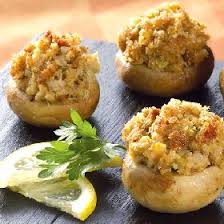
Cheesy Shrimp-Stuffed Mushrooms

I love a savory stuffed mushroom! This is where I go first when I hit the holiday buffet. The other day at the deli in my supermarket I came across a freebie recipe card for these Cheesy Shrimp-Stuffed Mushrooms. They have bacon, shrimp, and cheese in them. I'm in love! You get 5 grams of protein to 1 gram of carbohydrate and only 3 grams fat. Here is the recipe. Send me your pictures if you make these and happy munching! I think the filling would make a great meal when stuffed in a portobello mushroom.


Cheesy Shrimp-Stuffed Mushrooms

6 slices bacon (try turkey bacon to lower the fat)
12 large fresh button mushrooms
1/4 pound peeled and deveined cooked shrimp
1/2 cup finely shredded Cheddar cheese
2 cloves garlic, minced
1/4 teaspoon cayenne pepper
1/8 teaspoon ground thyme leaves

In a large skillet cook bacon on medium-high heat 4 minutes; turn and cook 4 minutes more. Bacon should be cooked but not crisp. Remove bacon from skillet and drain on paper towels. Pour off excess fat from skillet, set aside.

Cut 4 of the bacon slices into 3 equal pieces for garnish. Chop the remaining 2 slices of bacon; set aside. Clean mushrooms; remove stems. Reserve mushroom caps. Chop stems; set aside. Chop shrimp; set aside.

Combine chopped bacon, chopped mushroom stems and chopped shrimp with cheese, garlic, cayenne pepper and thyme in large bowl. Fill each mushroom cap with bacon-shrimp mixture.

Reheat skillet over medium-high heat. Top each filled mushroom cap with 1 bacon piece; place stuffed mushrooms in hot skillet. Cover; reduce heat to medium-low. Cook unitl mushrooms are tender, about 15 minutes. (You could also bake these in a preheated 350F oven for 20-25 minutes).

Serve warm.

1 stuffed mushroom is 51 calories, 5g protein, 3g fat, 1g carbohydrate.

More Great Recipes

Friday, September 12, 2008

Delicious Wine Reductions for Cool Autumn Nights

So we've had weight loss surgery and are happily losing weight with a restricted diet and the improved ability to exercise. But you know, we didn't have taste bud surgery! We still have taste buds that crave delicious foods - we just want the foods we eat to be satiating and good for us.

Let me tell you a culinary secret - it's in the wine! I'm not talking about wine in the glass, I'm talking about wine in a recipe. Wine reductions are wonderfully simply to make, rich in flavor and can be low in fat. Most recipes for wine reductions call for added fat (butter) but should be adjusted to use about 1/3 the fat called for.

We know that most gravies are fat laden, heavy with starch and lacking nutritional value. Simply put gravy is empty fat calories we do not need in our LivingAfterWLS diet. Anyone watching their weight is wise to avoid gravies (particularly mass-produced gravies served in restaurants).

For a better flavor and health select or make a wine reduction. A reduction contains the wine's antioxidants, called flavonoids which are proven to reduce the production of LDL (bad) cholesterol and boost the HDL (good) cholesterol. Scientists now believe these flavonoids may also inhibit tumor development in some cancers and may also be helpful in the treatment of neurological diseases.

Not an alcohol drinker? Not to worry, the alcohol cooks out of the reduction leaving nothing but the good stuff behind. If you are not familiar with wine ask your wine merchant to recommend a good bottle of reasonably priced cooking wine (don't buy the kind on the supermarket shelf - it has too much sodium). Your wine steward can also offer suggestions for re-corking the wine as seldom will you use a full bottle for any single recipe.

For five delicious wine reduction recipes visit the LivingAfterWLS Kitchen

Chicken with White Wine and Mushrooms
Seared Halibut with Green Beans, Scallions and White Wine Sauce
Salmon with Mushrooms and Red Wine Sauce
Beef Medallions in Red Wine Sauce
Cornish Game Hen with Raspberry Red Wine Sauce

I've personally tried and adapted these recipes to have lower fat while preserving the delicious flavor and texture of a reduction. I hope you will incorporate a wine reduction recipe in your lifestyle. Also - these are all very quick to fix - you'll be surprised how much flavor you get for so little effort! Cheers!

Thursday, July 31, 2008

What's Your Rhythm?

Over at the LivingAfterWLS Neighborhood in WLS Chat we have been talking about the 2B1B Rhythm. Do you know what that is? It is a method of counting food bites to make sure you get 66% protein and 33% complex carbohydrates. With the 2B1B Rhythm it is assumed that one has made a low-fat selection food choice and that processed or "white" carbs are not on the plate.

Our Ambassador of Reception "N A" was first to identify the acronym as 2 Bites Protein; 1 Bite Carbs. The conversation has continued as others have identified their own rhythms. Celadon said, "This is the first time I have seen this thread. I am more of a 3B1B person but I just really feel like I still need the protein more. Silly stuff tends to keep us focused now doesn't it?"

I added, I'm loving the 2B1B Rhythm conversation!!! And it looks like we all have rhythm - - - just different rhythms. Honestly, I've found the 2B1B Rhythm to be less intimidating and more user friendly than calorie counting or clock watching or any of the other gimmicks I have employed in weight loss/weight maintenance efforts.

Ahhhh, but with any good rhythm, one must listen for the ending notes. The final curtain call. The last fork standing.

What is the curtain call on your personal fork dance? Click to learn how the Neighbors are dancing to the rhythm of the fork!